Audio player docked to bottom
Listen to this article
Introduction: The Lifeblood of Your Electrical Assets
A transformer failure can cost millions in equipment damage, lost revenue, and emergency repairs—but the warning signs are almost always there, dissolved invisibly in the oil, months or even years before disaster strikes.
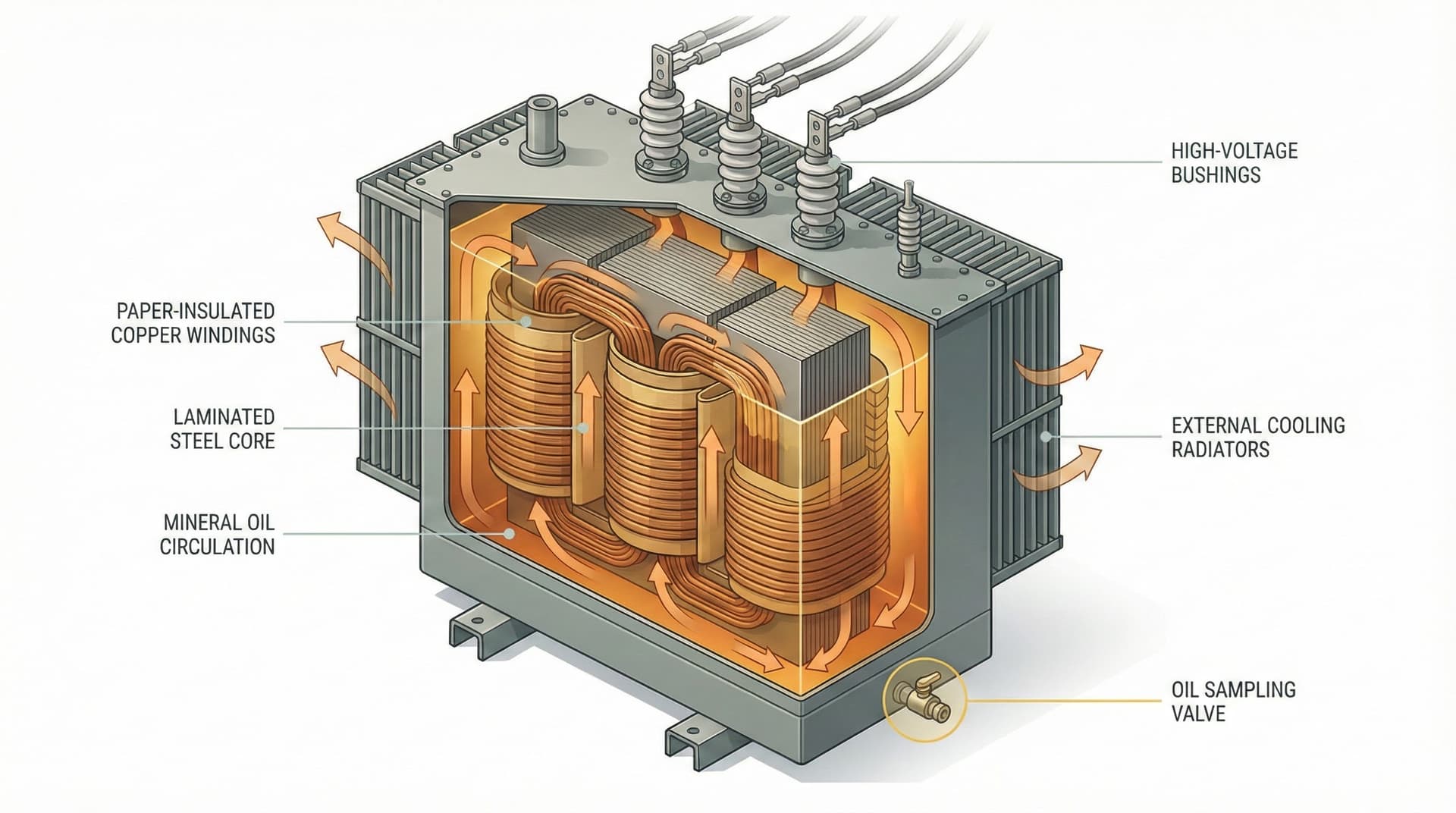
Think of the insulating liquid inside a power transformer as its lifeblood. Just as a doctor can run a blood test to understand a patient's health, engineers can analyze a small sample of this liquid to diagnose the condition of critical electrical equipment worth millions. The key is knowing what to look for.
According to international standards like IEC 60296, these specialized liquids serve two primary, non-negotiable functions:
Insulation: The liquid is a powerful electrical insulator. It fills the spaces between internal high-voltage components, preventing electricity from jumping—or "arcing"—between them. Without it, a massive short circuit would occur, destroying the equipment.
Cooling: As electricity flows, the active parts of the equipment generate immense heat. The insulating liquid absorbs this heat and carries it away to the cooling system, preventing the components from overheating and melting down.
These essential liquids are used in a variety of high-voltage equipment, but they are most commonly associated with power transformers, instrument transformers, bushings, and certain types of switching equipment and cables.
But these liquids do more than just insulate and cool—they also carry vital information about what's happening deep inside the equipment.
How Oil Tells the Story of Equipment Health
So how does a silent pool of oil reveal what's happening inside sealed, energized equipment?
Internal stresses within a transformer—extreme temperatures, electrical discharges, or chemical degradation—cause the insulating liquid and solid insulation (paper) to slowly decompose. This breakdown of materials is the fundamental principle behind oil diagnostics.
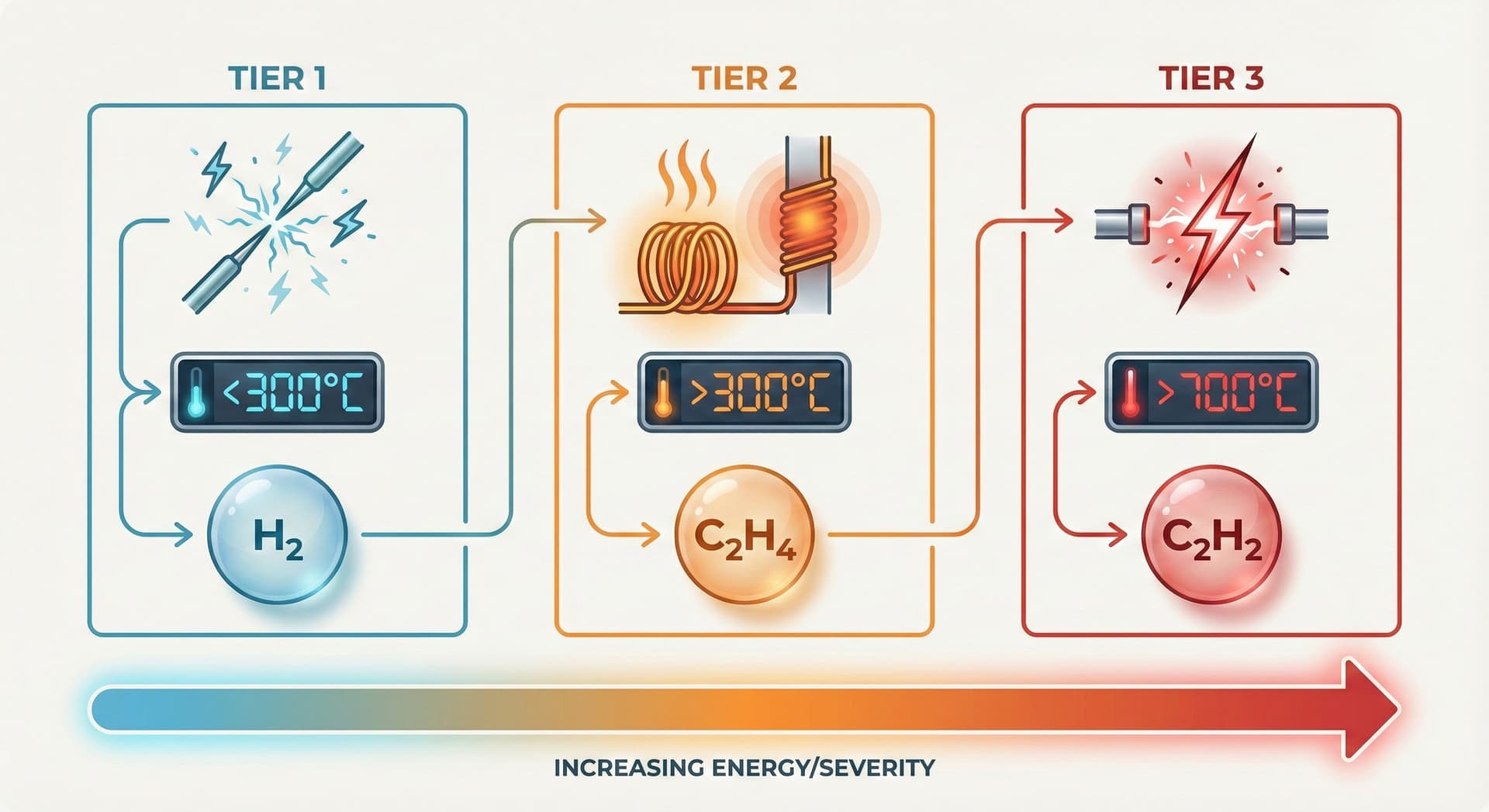
As explained in IEC 60599, different types of faults produce different types of gases. The process is similar to how different cooking temperatures produce different results:
- Low-energy events like minor partial discharges only break the weakest chemical bonds in oil molecules, primarily producing hydrogen (H₂).
- Higher-energy thermal events like severe overheating above 500°C break stronger carbon-carbon bonds, creating gases like ethylene (C₂H₄).
- Extreme-energy events like powerful electrical arcs (800°C+) are so violent they vaporize the oil, creating acetylene (C₂H₂).
The unique combination and proportion of these dissolved gases create a "chemical fingerprint" that tells a trained analyst exactly what kind of stress the equipment is experiencing.
Decoding the Messages: Key Properties We Monitor
Engineers and technicians monitor several key properties to assess equipment health. Six of the most important are Dissolved Gas Analysis, water content, acidity, dielectric strength, dielectric dissipation factor (DDF), and interfacial tension.
Dissolved Gas Analysis (DGA): The Chemical Fingerprint
Cited by IEC 60599 and IEEE C57.104 as the most important diagnostic tool, Dissolved Gas Analysis measures the specific gases dissolved in the insulating liquid. By analyzing this "fingerprint," we can identify the type and severity of developing faults.
Here are the three most significant fault gases:
| Key Gas | What It Tells You | Urgency Level |
|---|---|---|
| Hydrogen (H₂) | Often the first sign of a problem—low-energy activity like partial discharges (corona) | Monitor |
| Ethylene (C₂H₄) | Significant thermal fault—oil overheating above 300–500°C | Warning |
| Acetylene (C₂H₂) | The most critical alarm—temperatures over 800°C from destructive electrical arcing | Critical |
For a deeper dive into DGA interpretation methods, see our guide: Navigating the DGA Maze: IEC vs IEEE vs CIGRE.
Water Content: The Silent Destroyer
As outlined in IEC 60422, water is a major enemy of the insulation system. Even in small amounts, it has profoundly negative effects:
- It drastically lowers the liquid's breakdown voltage—wet oil simply can't insulate as effectively, increasing the risk of internal flashover.
- It accelerates the aging of paper insulation wrapped around the conductors, making the cellulose brittle and mechanically weak over time.
Acidity: The Aging Clock
Over years of service, insulating liquid slowly oxidizes, creating acidic compounds. According to IEC 62021-3 and IEC 60422, monitoring acidity tracks the oil's overall aging. High acidity signals advanced degradation and leads to corrosion of internal metal parts and accelerated damage to paper insulation.
Dielectric Strength (Breakdown Voltage): The Ultimate Test
Dielectric strength is a direct measure of the liquid's ability to do its primary job: insulate. The test (IEC 60156) applies increasing voltage across electrodes submerged in the liquid until an arc passes through. The voltage at which this occurs is the breakdown voltage—a property severely degraded by water and conductive particles.
Dielectric Dissipation Factor (DDF): The Contamination Detector
Also known as tan δ (tan delta), the dielectric dissipation factor measures energy losses in the oil when subjected to an alternating electric field. It's an exceptionally sensitive indicator of oil quality and contamination.
According to IEC 60422, DDF is:
"Very sensitive to the presence of soluble polar contaminants, ageing products, or colloids in the oil" and can detect contamination "even when contamination is so slight as to be near the limit of chemical detection."
What makes DDF particularly valuable is its ability to detect contamination at extremely low levels—often before other tests show any abnormality. It responds to:
- Polar contaminants from oxidation and aging
- Moisture dissolved in the oil
- Conductive particles and colloidal suspensions
- Chemical byproducts from insulation degradation
DDF complements IFT as a sensitive early warning marker. While IFT tracks the gradual accumulation of degradation products over time, DDF can spike rapidly in response to acute contamination events, making the two tests powerful partners in a comprehensive monitoring program.
Interfacial Tension (IFT): The Early Warning System
While DGA catches acute faults and acidity reveals advanced aging, interfacial tension fills a critical gap: it detects the earliest stages of oil degradation, often before other parameters show any change.
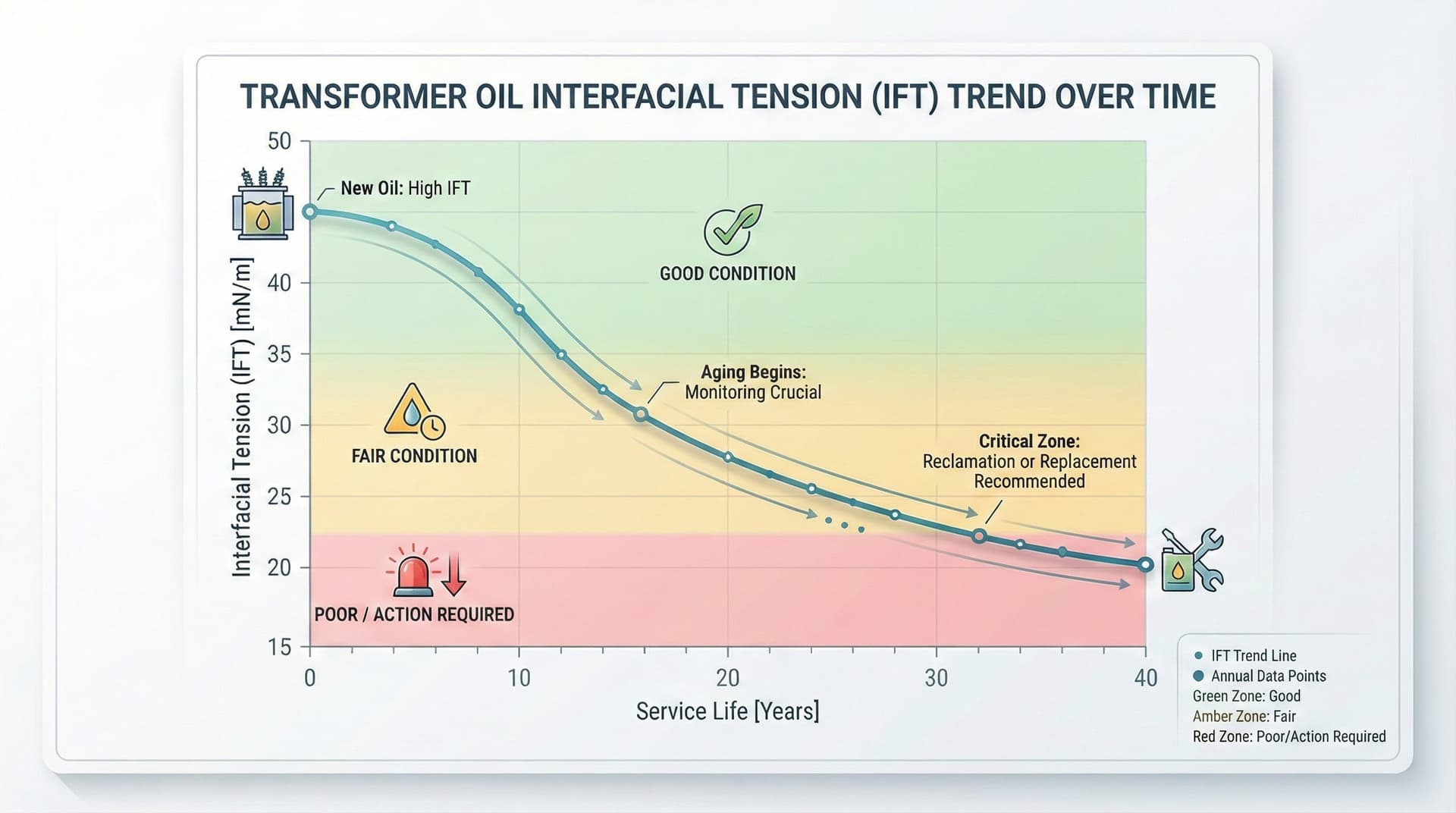
IFT measures the tension at the boundary between oil and water—a property that drops when polar contaminants and degradation products accumulate. According to IEC 60422:
"Interfacial tension can change rapidly during the initial stages of ageing but levels off when deterioration is still moderate."
What makes IFT particularly valuable is its trending behavior. A new mineral oil typically has an IFT around 40–50 mN/m. As the oil ages, this value declines steadily—creating a smooth, predictable curve that reveals the rate of degradation over time. When IFT approaches 22 mN/m, the oil requires investigation or reclamation.
Think of IFT as your transformer's "fitness tracker"—it won't tell you about a sudden injury (that's DGA's job), but it shows whether your equipment's overall condition is declining gradually, giving you time to plan maintenance before problems escalate.
For a deep dive into IFT diagnostics — including the new fluid-specific limits in IEC 60422:2024 (mineral oil), IEC 61203:2025 (synthetic ester), and IEC 62975 (natural ester, draft) — see our companion guide: Interfacial Tension: The Most Underrated Test in Your Transformer Oil Programme.
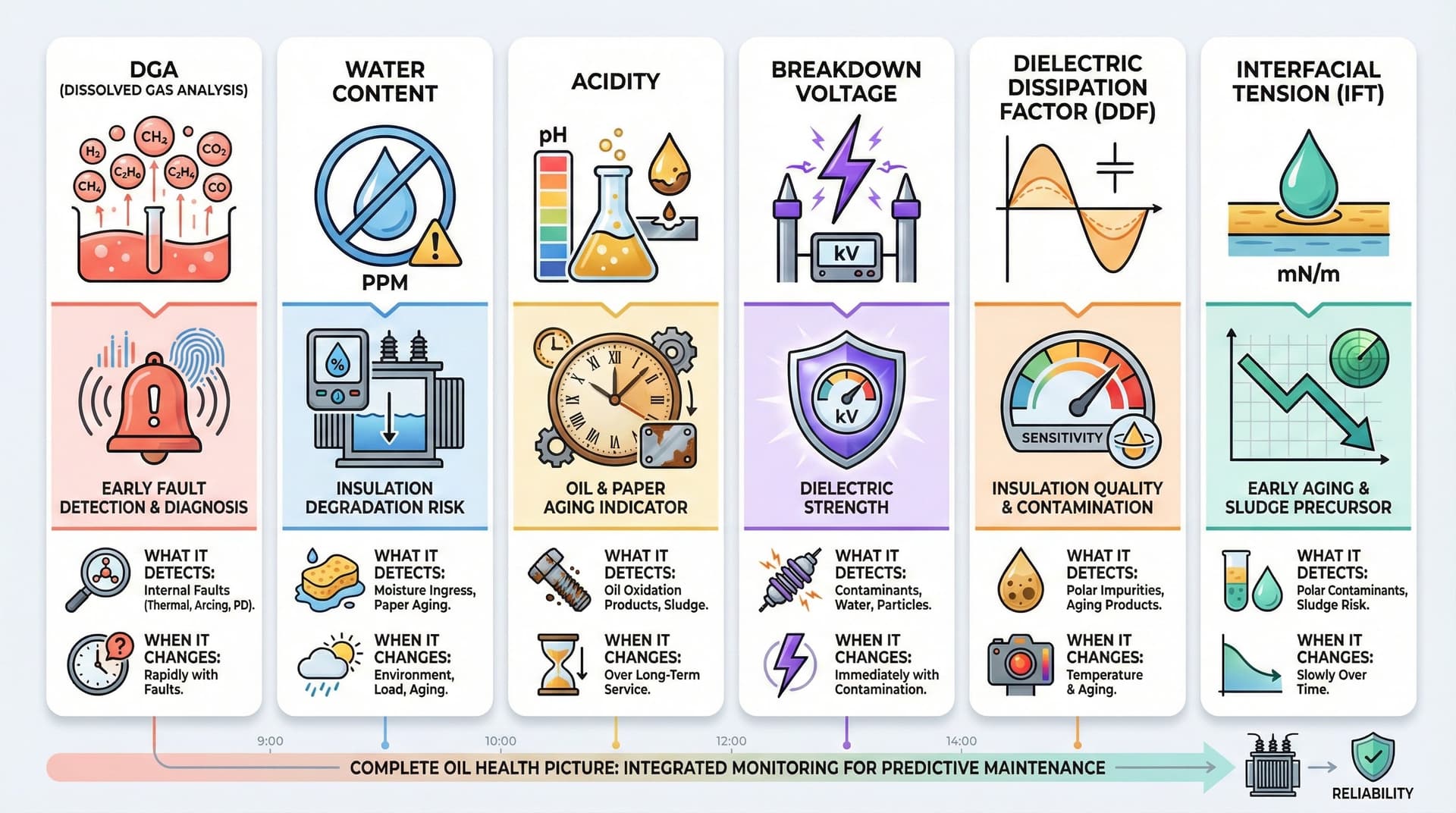
While these oil parameters reveal critical information about your transformer's current condition, the paper insulation inside tells another vital story. Learn why traditional DP thresholds may need rethinking: Is a Low DP Score Really a Death Sentence for Your Transformer?.
The Importance of Regular Testing: Preventing Failure Before It Happens
The primary goal of regular testing isn't just to find faults—it's to find incipient faults, problems that are just beginning to develop, long before they can escalate into catastrophic failures.
Strong return on investment. Industry experience and CIGRE economic studies of condition-based monitoring programmes consistently report that proactive DGA monitoring avoids multiple times the monitoring cost in failure-related expense. CIGRE TB 642 (2015) and CIGRE TB 783 (2019) on transformer fleet-management economics provide the formal framework; the realised ratio depends heavily on fleet age, criticality, and intervention discipline. Few maintenance investments offer that kind of payback.
As IEEE C57.104 highlights, this proactive approach is the cornerstone of modern equipment maintenance.
Trending Is Key
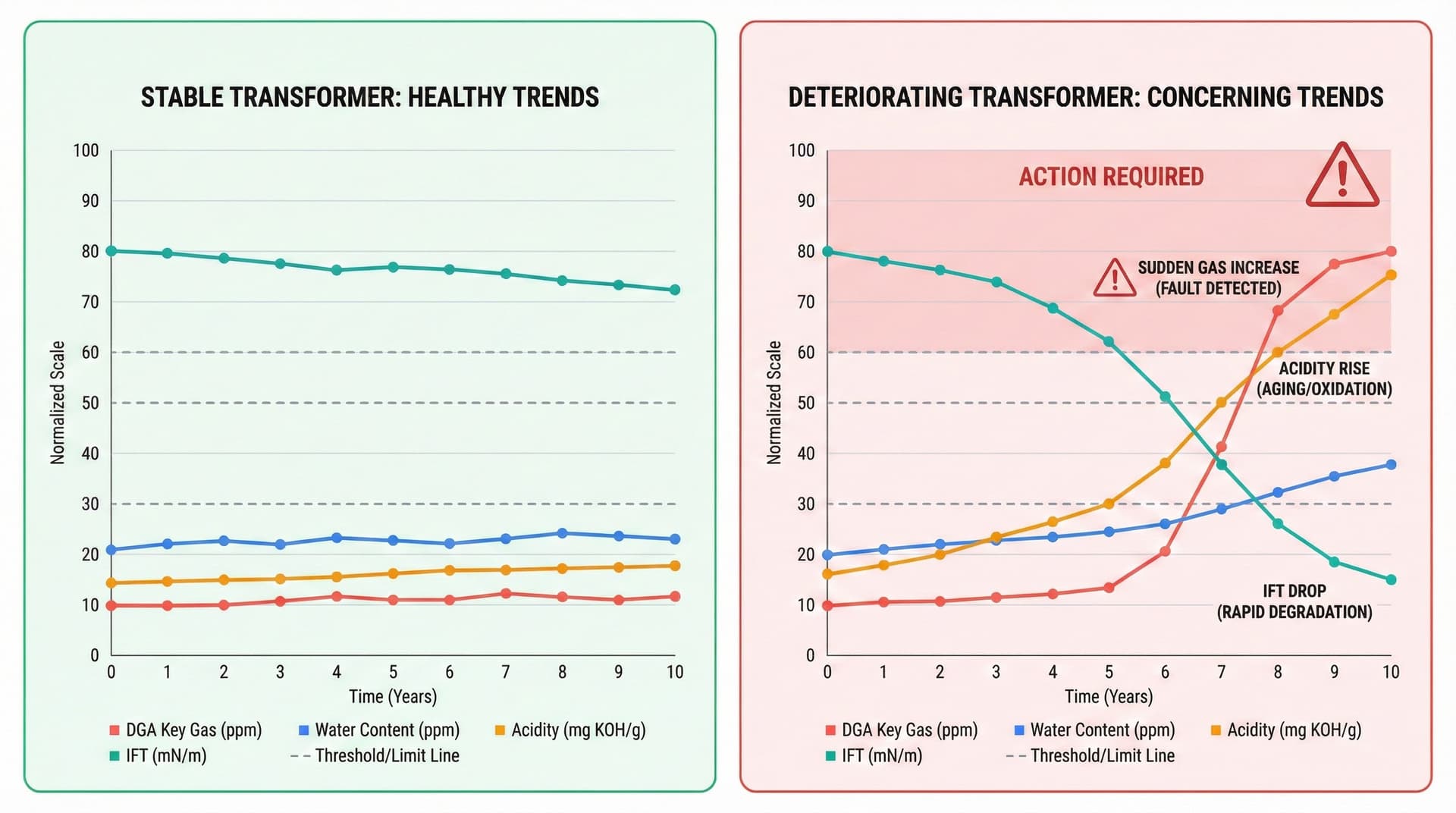
A single test result is just a snapshot in time. The real insight comes from trending—observing the rate of change over multiple tests. A slow, steady increase in a gas might be acceptable, but a sudden, rapid increase signals an urgent problem requiring immediate attention.
This focus on "rates of gas increase" is central to modern DGA interpretation (IEC 60599). The same principle applies to IFT: it's not just the absolute value that matters, but how quickly it's declining.
Process Matters
To get reliable data, the testing process must be meticulous. This involves two critical steps defined by international standards:
Careful Sampling: A representative sample must be drawn from the correct location using sterile, specialized containers and strict procedures to avoid contamination (IEC 60475). A poorly taken sample can invalidate the entire analysis.
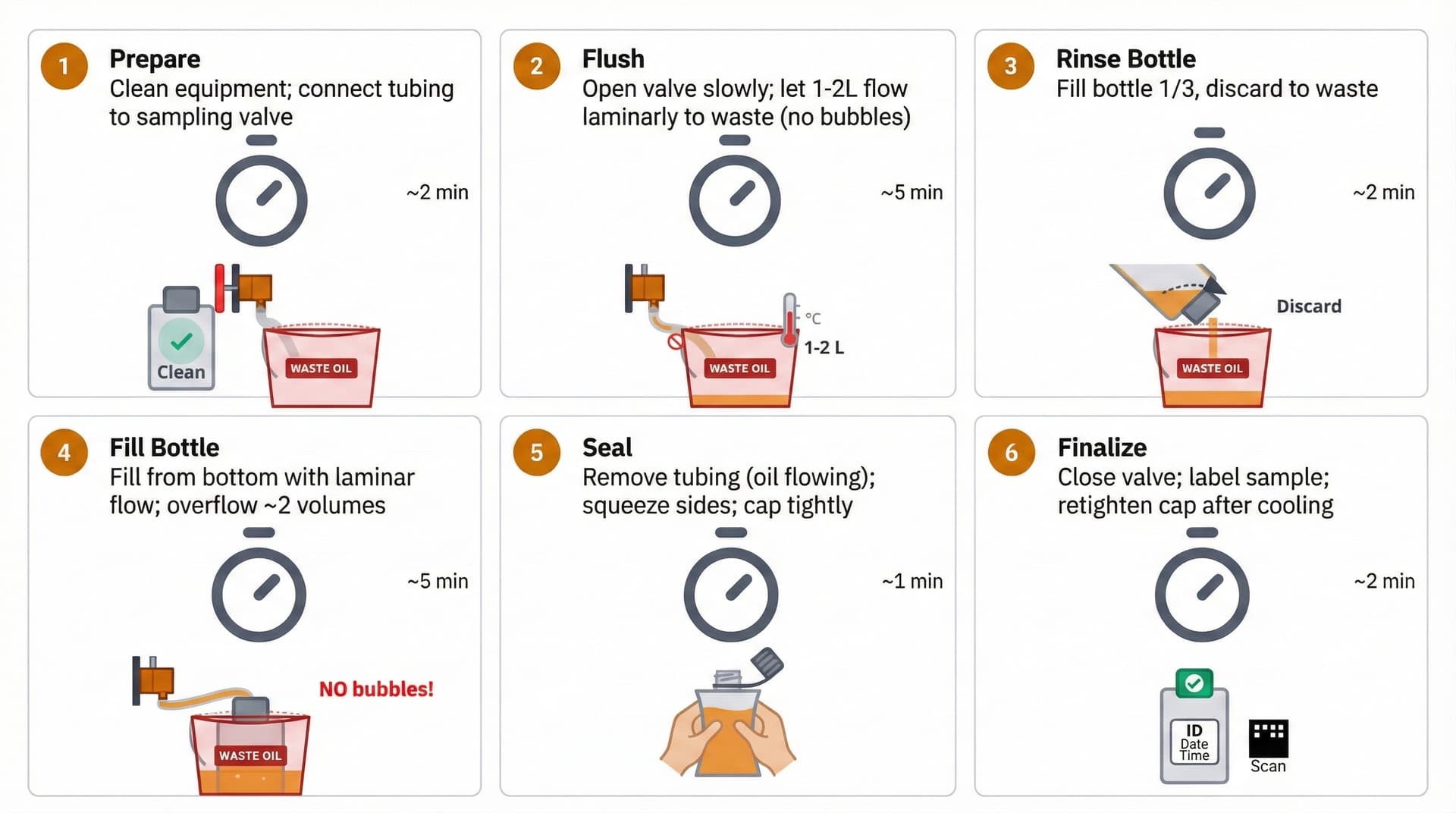
See our complete visual sampling guide for step-by-step instructions.
Precise Analysis: The sample is analyzed in a laboratory where dissolved gases are extracted and measured using highly sensitive equipment like gas chromatographs, according to standardized methods (IEC 60567).
This methodical process of sampling, analyzing, and trending transforms technical data into actionable intelligence.
Conclusion: Listening to What Your Transformers Are Telling You
The insulating liquid in high-voltage equipment is far more than a simple component—it is the lifeblood that ensures safe operation and carries the diagnostic story of the equipment's internal health. By performing regular analysis, we can listen to this story and act decisively to prevent failures.
Three key takeaways:
-
Insulating liquids are essential workers: They perform the critical dual jobs of insulating high-voltage components and cooling the entire system to prevent overheating.
-
Oil is a silent storyteller: Its chemical properties—especially dissolved gases and interfacial tension—change in direct response to internal conditions, providing a reliable diagnostic record of equipment health.
-
Proactive testing prevents failures: By regularly sampling and analyzing oil, asset managers can detect developing problems before they lead to catastrophic failures, costly repairs, and dangerous outages.
This diligent monitoring, performed one sample at a time across thousands of assets, is a crucial—and often unseen—part of maintaining the safe, reliable electrical grid that powers our world.
Ready to Start Listening?
TriboTech's comprehensive oil analysis includes all the parameters covered here—DGA, water content, acidity, breakdown voltage, DDF, and interfacial tension—providing you with a complete picture of your equipment's health in a single test package.
Whether you're establishing a new monitoring program or looking to enhance your existing approach, our specialists can help you make sense of the data and turn it into actionable maintenance decisions.
Contact us to discuss your monitoring program →
References
- IEC 60422:2024 (ED5): Mineral insulating oils in electrical equipment — Supervision and maintenance guidance (supersedes IEC 60422:2013 ED4)
- IEC 60599:2022 (ED4): Mineral oil-filled electrical equipment in service — Guidance on the interpretation of dissolved and free gases analysis
- IEC 60296:2020 (ED5): Fluids for electrotechnical applications — Mineral insulating oils
- IEEE C57.104-2019: IEEE Guide for the Interpretation of Gases Generated in Mineral Oil-Immersed Transformers
- IEC 60475: Method of sampling insulating liquids
- IEC 60567: Oil-filled electrical equipment – Sampling of gases and analysis of free and dissolved gases
Put Theory into Practice
Try our interactive Duval diagnostic tools or use our new unified workflow to analyze your transformer oil data.