Audio player docked to bottom
Listen to this article
Key takeaway
Fire point is the single property that decides whether a transformer liquid is legally "less-flammable" — and therefore whether the unit can sit indoors, close to a building, or without a fire-rated vault. For esters that line is 300 °C, and the headroom is thin: an unused synthetic ester is only about 315 °C, so a few percent mineral-oil contamination can quietly push an in-service unit below 300 °C and revoke its less-flammable basis without reliably tripping any other routine test. That is the case for treating fire point as a risk-tiered routine parameter on ester units. For turbine control fluids the logic inverts entirely — fire point is not the fire-resistance gatekeeper there.
1. Why fire point is the property that matters
Most fluid parameters tell you about condition — how far the oil has aged, how much water it carries, whether a fault is generating gas. Fire point is different. It tells you about compliance. It is the single measured property that determines whether a transformer liquid counts as "less-flammable" under the codes that govern where and how a transformer may be installed.
The threshold is 300 °C. A fluid whose fire point is at or above 300 °C qualifies as a less-flammable (IEC 61039 "K") liquid; below 300 °C it does not. That one number unlocks a relaxed installation regime: indoor siting without a fire-rated vault, reduced clearances to buildings, and a higher containment threshold (IEC 61039:2025, Clause 5.3; NEC/NFPA 70 Article 450.23, as cited by IEEE C57.147-2018).
This matters to the asset owner in a specific, practical way. If an ester-filled transformer was placed indoors or close to a building because its fluid was less-flammable, then a fire point that drifts below 300 °C is not a fluid-quality footnote — it is a potential compliance and insurance event. The rest of this whitepaper walks the full arc: what fire point is, how it is measured, how it classifies a fluid, how it moves in service, when to monitor it, and why the same property plays the opposite role for turbine control fluids.

2. Fire point versus flash point
Two distinct ignition temperatures are measured in the same apparatus, and only one of them is the classification parameter.
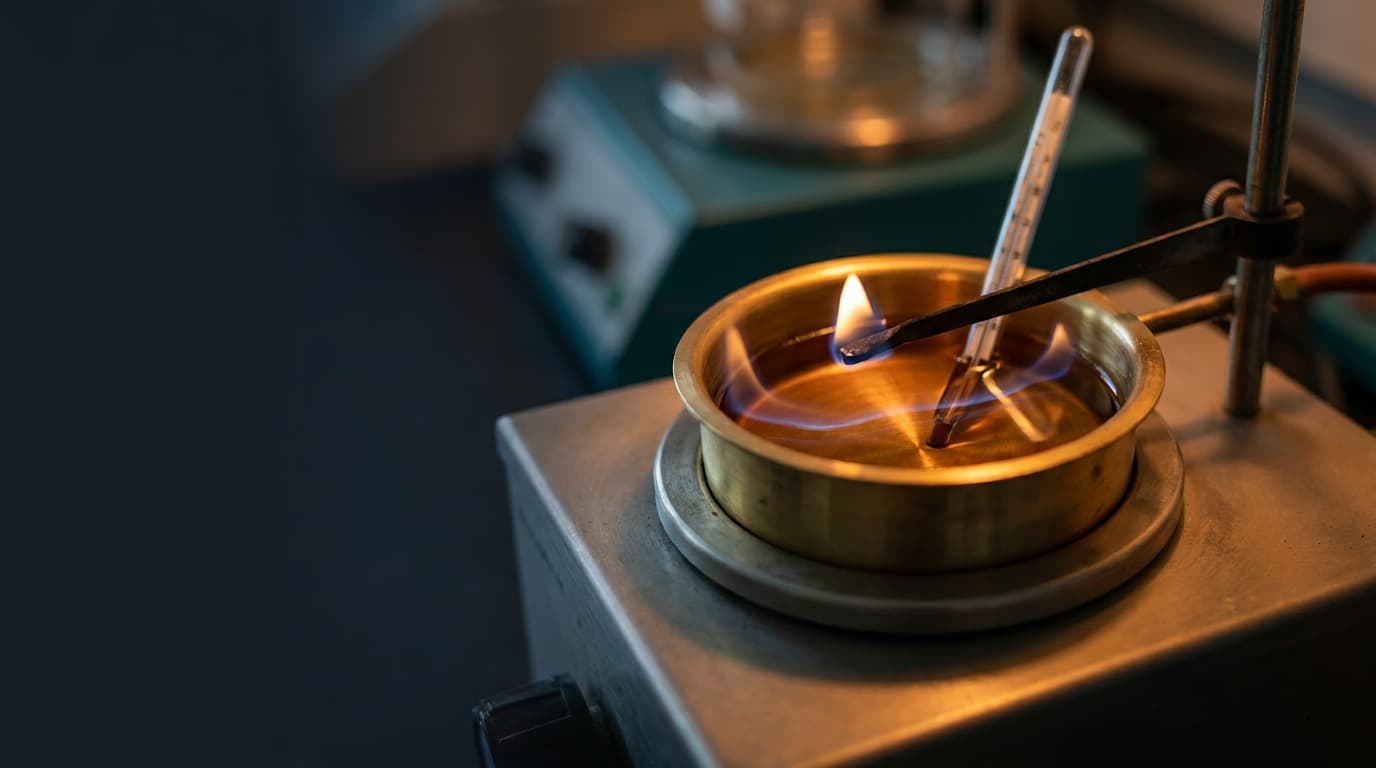
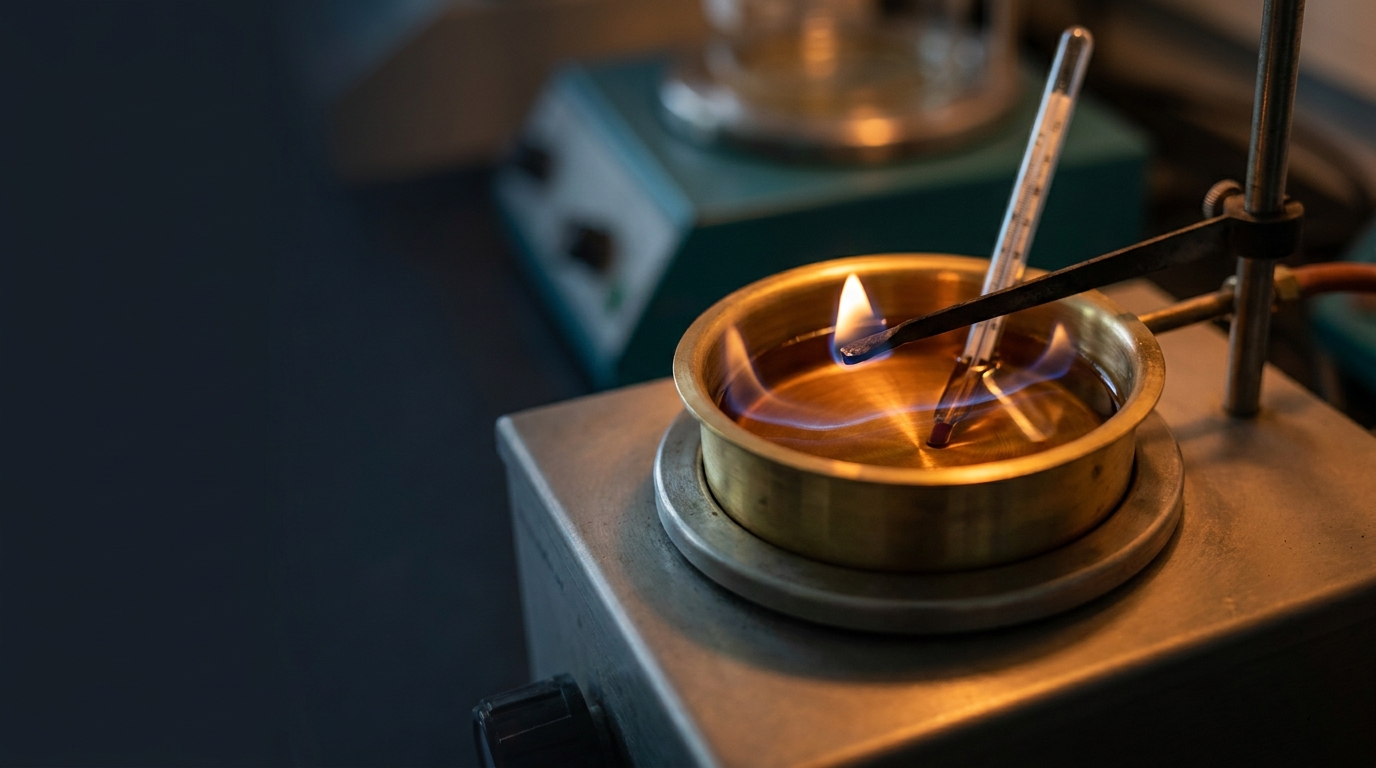
Flash point is the lowest temperature at which the vapours above the fluid ignite momentarily when an ignition source is applied — the flame flashes across the surface and goes out, because the fluid is not yet producing vapour fast enough to keep burning (ISO 2592:2000, Clause 3.1; ASTM D92-24, Clause 3.1.4).
Fire point is the lowest temperature at which the vapours ignite and sustain burning for at least 5 seconds (ISO 2592:2000, Clause 3.2; ASTM D92-24, Clause 3.1.3). It is always higher than the flash point because sustained combustion needs a faster, self-supporting vapour supply.
That five-second distinction is the whole reason fire point — not flash point — is the classification parameter. A flash is a transient event; sustained combustion is the property that determines whether a spill or a rupture can actually spread fire. So the 300 °C line that separates less-flammable fluids from ordinary ones is defined on the fire point (IEC 61039:2025, Clause 5.3).
What this means for the practitioner. When you read a fluid datasheet or an in-service report, check which property you are looking at. A high flash point alone does not make a fluid less-flammable; mineral oil has a perfectly respectable flash point of 135 °C (IEC 60296:2020, Tables 3–4) and is still an ordinary, fully-flammable O-class fluid. Only the fire point speaks to classification, and only the fire point ≥ 300 °C earns K status.
3. How it is measured — open cup versus closed cup
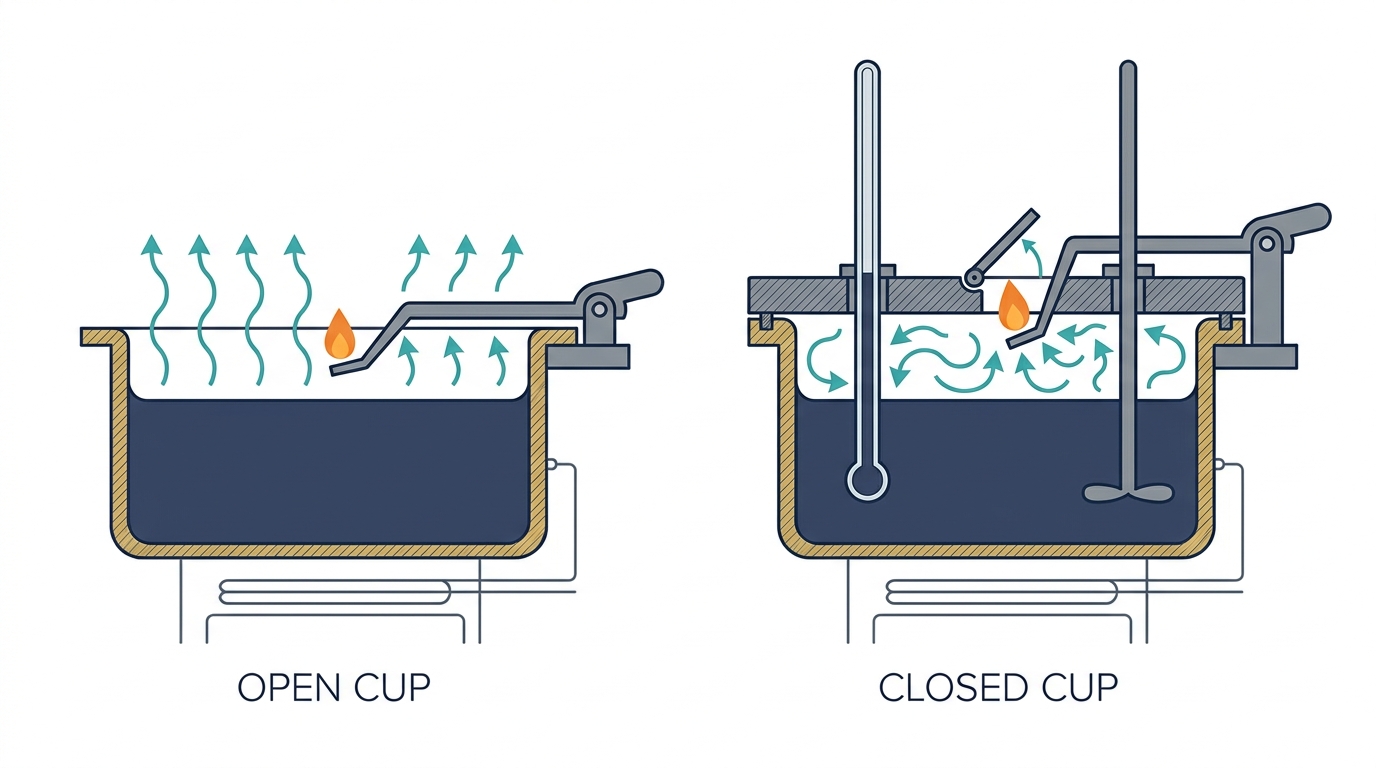
Fire point can only be measured in an open cup. This is not a formality; it is a hard constraint that determines whether a reported number is even valid.
The Cleveland open cup (ISO 2592 / ASTM D92) holds the fluid in an open dish; vapours escape freely, and the test can measure both the flash point and the fire point. The Pensky-Martens closed cup (ISO 2719 / ASTM D93) confines the vapours under a lid and can measure the flash point only — a closed cup cannot determine a fire point at all (ASTM D93-26, Clause 1; ISO 2592:2000, Clause 1). The fire point used for IEC 61039 classification is specifically the ISO 2592 (open cup) value (IEC 61039:2025, Clause 5.3).
Three measurement realities matter when a result lands near the 300 °C line:
Method must be stated, and there is no cross-correlation. Because results are method-dependent and there is no general valid correlation between methods (ASTM D92-24, Introduction), every flash or fire point must declare its method. A "fire point" quoted from a closed-cup tester is simply invalid — rule that out first. (Worth noting: IEC 62770 deliberately switched the flash-point method for natural ester from Pensky-Martens to open cup, because the closed-cup method is unreliable on esters.)
Barometric correction is real but small. Both points are corrected to 101.3 kPa using a sensitivity of 0.25 °C per kPa (ISO 2592:2000, Clause 12.2). At a Danish sea-level laboratory the altitude term is negligible; the real variable is the weather. A passing low or high shifts the raw reading by roughly ±1 °C, which only changes a verdict when a result sits within a degree or two of 300 °C — and only if the correction was not applied. It cannot explain a reading many degrees off: a 286 °C result is not a weather artefact.
Reproducibility is not a tolerance band. This is the most-abused number in fire-point interpretation. ISO 2592 fire-point reproducibility is R = 14 °C (ISO 2592:2000, Clause 14) — the maximum expected difference between two single results on the same oil from different labs. It is not a ±14 °C acceptance band around the 300 °C limit. The standard deviation of a single between-lab result is roughly 5 °C (the ISO 5725 precision identity R ≈ 2.8 σ). Because 300 °C is a one-sided minimum, the only question is whether the true value could be ≥ 300 °C:
- 297 °C is about 0.6 σ below 300 — genuinely within scatter (roughly a 1-in-4 chance the true value clears 300). Re-test; it may comply.
- 286 °C is about 2.8 σ below 300 — statistically distinguishable from 300 (roughly 1-in-300 odds of truly being ≥ 300). This is a real failure, not method noise.
In every case, re-test on a fresh sample before acting — but for a result well below 300, do not expect the re-test to rescue it. A same-lab re-test is governed by the tighter repeatability of r = 8 °C; the wider R = 14 °C is the right tool only when you are comparing your lab against a different one, such as a supplier certificate.
4. The fire classification of insulating liquids — IEC 61039
IEC 61039:2025 Classification of insulating liquids is the standard
that gives a transformer fluid its formal fire-and-energy
classification. It builds a structured code of the form
L‑CLASS‑CATEGORY‑NUMBERS — for example L-NTUO-2960121 for a
mineral insulating oil (IEC 61039:2025, Clauses 4–5).
For fire safety the load-bearing element is the fourth category letter, which encodes the fire point measured per ISO 2592:
- O if the fire point is below 300 °C
- K if the fire point is 300 °C or above
- L if the fire point is not detectable (a category being phased out)
(IEC 61039:2025, Clause 5.3.) A fluid whose fire point is exactly 300 °C is K — the equality sits in the K class in the published edition. The first three letters carry separate information: N marks the electrical-insulation family, the second letter the application (T for transformers), and the third the antioxidant state (U uninhibited, I inhibited).

Terminology precision — "K class" is a colloquialism
Vendor sheets and CIGRE papers routinely say "K-class fluid". Formally, the class is L; K is only the fourth-position fire-point letter of the category code. IEC 61039 does not define a "K class". The precise phrasing is "L-NTUK category fluid (fire point ≥ 300 °C)". The colloquial "K-class" is widely understood and fine in narrative — but respect the distinction in formal documentation.
The second axis — net calorific value
Fire point is not the only fire-relevant property. A fifth digit in the code carries the net calorific value — how much heat a fire would release once started (IEC 61039:2025, Clause 5.4): 1 for ≥ 42 MJ/kg, 2 for between 32 and 42 MJ/kg, 3 for below 32 MJ/kg. Two fluids can share a fire point yet differ greatly in how much fuel energy a fire would have to sustain and spread it — a lower number means less energy available (CIGRE A2-210).
Applied to real fluids, the classification produces (CIGRE A2-210, Table I): mineral oil → O, synthetic ester → K (low-energy "3"), natural ester → K (energy digit "2"). Both esters are K on fire point but differ on the calorific axis, consistent with their respective low heat values.
Not all mineral oil is O-class
One useful exception keeps the picture honest. An engineered less-flammable mineral oil — a high-molecular-weight hydrocarbon made to ASTM D5222 — reaches a fire point of at least 300 °C (ASTM D5222-23, Clause 1.2 and Table 1) and so qualifies as a K fluid under the same NEC 450.23 / IEC 61039 logic. Ordinary transformer mineral oil is O-class; an HMWH product built to D5222 is not. The classification follows the fire point, not the chemistry label.
5. Fire point by fluid type — and how it moves in service
The per-fluid picture is set at manufacture by the specifications, and then moved (almost always downward) by what happens in service.
| Fluid | Spec fire point (min.) | Typical unused | Class | Source |
|---|---|---|---|---|
| Mineral oil (transformer) | none (O-class) | ~145–170 °C | O | IEC 60296:2020 (no FP req.); CIGRE A2-210 |
| Synthetic ester (MIDEL 7131-type) | 300 °C | ~315 °C | K | IEC 61099:2010; IEC 61203:2025 Annex B.1 |
| Natural ester (FR3 / MIDEL eN) | 300 °C | ~330–360 °C | K | IEC 62770:2024, Table 2 |
| Silicone (PDMS) | 340 °C | > 340 °C | K | IEC 60836:2015, Table 1 |
| Turbine EHC phosphate ester | 352 °C (OEM) | ~350–360 °C | (HFDR — see §7) | GE GEK-46357g |
The headroom column is the story. Synthetic ester clears 300 °C by only about 15 °C in unused condition (IEC 61203:2025, Annex B.1 records the unused value as "about 315 °C or greater"). Natural ester starts much higher, silicone higher still. Mineral oil is nowhere near it. That thin synthetic-ester margin is what makes monitoring worthwhile, because four in-service mechanisms move the number:
- Residual mineral-oil leach-out after retrofill (↓). When a mineral-oil transformer is retrofilled with ester, mineral oil trapped in the cellulose leaches into the fluid over weeks. Mineral oil's ~150–170 °C fire point drags the miscible mixture down roughly in proportion to the volume percentage present. This is the dominant and most sensitive driver.
- Wrong-fluid top-up or ingress (↓). The same dilution physics, introduced operationally — a mineral-oil top-up, or cross-contamination from shared filling equipment (IEC 61203:2025, §9.7).
- Thermal or oxidative degradation (↓, but a late indicator). Sustained overheating cracks the ester into lighter fragments, lowering the fire point. But because the fire point is intrinsically stable in clean fluid, a degradation-driven drop implies significant thermal stress — DGA fault gases and acidity move first. Fire point is a meaningful but insensitive degradation flag.
- Sampling artefact — light-end loss (↑, and this is the trap). Losing volatile light ends during sampling raises the apparent fire point, which can mask mineral-oil contamination (IEC 61203:2025-aligned; classification article §6).
The directional asymmetry is the practical point. Three mechanisms pull the fire point down; one pushes it up and can produce a falsely reassuring result. That is the strongest argument for never reading fire point in isolation — always pair a low or suspiciously-high value with a direct mineral-oil quantification by GC or FTIR.
The retrofill ceilings make the contamination case concrete. To hold a mixture's fire point at or above 300 °C, residual mineral oil must stay below approximately 3.5 % by volume for synthetic ester and below about 7 % by volume for natural ester (IEC 61203:2025, Annex B.1, for synthetic; IEC 62975:2019, Annex B.1, and IEEE C57.147-2018 §1.4 for natural). The difference is pure chemistry: synthetic ester's ~15 °C headroom is consumed by a few percent mineral oil, while natural ester's larger margin absorbs more.

6. Why monitor — and why TriboTech makes it routine on esters
Here is the honest starting point: no standard requires routine fire point. In IEC 61203:2025, fire point is a Group 2 complementary test, not a Group 1 routine test, with no fixed interval (Table 2). The standard's own rationale is that fire point is stable in clean ageing fluid (§9.7): it "usually do not vary with time and deterioration of the liquid. However, fire point can indicate contamination, mainly with mineral oils." The required baseline is a single measurement before energization, then periodic by risk assessment thereafter.
So TriboTech's position is not "the standard mandates this". It is a consulting recommendation that operationalises the standard's own carve-out. The same §9.7 continues: "In some critical applications or as determined by a risk assessment, the fire point should be periodically measured … for example K class as defined in IEC 61039." The standard explicitly hands the risk-tiering decision to the engineer. We take it up.
Four verified points make routine fire point on esters defensible:
- The synthetic-ester margin is thin — about 15 °C above the 300 °C line.
- Low-percentage contamination is silent in the routine suite. A few percent mineral oil does not reliably trip viscosity, acidity, moisture or DDF at the sensitivity that fire point flags loss of K status. Fire point is the direct compliance metric.
- The consequence is binary. For an indoor or close-clearance unit sited on a less-flammable basis, dropping below 300 °C is a compliance event, not a quality drift — and a trend record is defensible documentation for insurers and regulators.
- Leach-out is time-delayed. A first-week fire point on a retrofilled unit can look compliant while the four-week value has drifted below 300 °C. A one-off commissioning check is insufficient on retrofilled units.
So we frame it risk-tiered:
- Baseline at commissioning — every unit. (The standard already requires this.)
- Routine (annual, or per sampling visit) on the populations the standard itself points to: retrofilled units, indoor or close-clearance K-class-dependent installations, and any unit with a top-up history.
- Periodic-by-risk-assessment on virgin-filled outdoor units with ample clearance.
And the honest caveat: on a clean virgin unit, fire point genuinely does not drift. There, the per-test information return is low, and we say so. The natural-ester maintenance guide IEC 62975:2019 follows the same maintenance-guide philosophy. The recommendation is not "test everything always" — it is "test where the risk and the chemistry say it will move."
The diagnostic ladder — when a result flags
When an in-service fire point sits at or below 300 °C, work the ladder:
- Verify. Confirm the method was Cleveland open cup, confirm barometric correction, and place the result against scatter (§3). Re-test on a fresh sample before acting.
- Diagnose. Separate the three causes — contamination (most common on retrofilled units), degradation, or sampling artefact — by quantifying residual mineral oil (GC/FTIR) and cross-checking DGA and acidity. The number alone does not tell you the cause; the supporting tests do.
- Act. If contamination is above the fluid's retrofill ceiling, the path is additional flushing or partial fluid replacement; if degradation, the path is reclaim or replace. Review installation compliance if the siting relied on less-flammable status. And re-check after several weeks of equilibration — leach-out continues after the intervention.
7. Beyond transformers — control fluids and fire-resistant hydraulics
Everything above rests on a single idea: a static fire point of 300 °C is the less-flammable criterion for a transformer liquid. For turbine control fluids and fire-resistant hydraulics, that idea inverts. Fire point is no longer the gatekeeper at all.
The reason is the failure mode. A transformer liquid sits at low pressure; the credible fire scenario is a spill or rupture forming a pool, and the question is whether that pool can sustain a fire — exactly what fire point measures. A hydraulic or turbine-control fluid runs at high pressure. A pinhole or line failure produces a fine atomised spray that ignites far more readily than a pool, often near hot metal. A static pool temperature does not capture that scenario at all.
So the fire-resistant hydraulic family — classified by ISO 6743-4 into HFAE, HFAS, HFB and HFC (water-based), and the anhydrous HFDR (phosphate esters) and HFDU (other synthetics), all specified by ISO 12922 — is judged by dynamic scenario tests, not by fire point. ISO 12922:2020 Table 3 sets the acceptance limits:
- Spray flame persistence (ISO 15029-1): the flame must extinguish within 30 s after the ignition source is removed (HFDR and HFDU).
- Hot-manifold ignition (ISO 20823): ignition temperature ≥ 700 °C for HFDR, ≥ 400 °C for HFDU.
- Wick flame persistence (ISO 14935): HFDR mean persistence ≤ 60 s; HFDU is report-only.
- Spray heat release (ISO 15029-2): reported, with no specified limit yet.
(All limits: ISO 12922:2020, Table 3, p. 10 — these are HFDR/HFDU hydraulic-fluid acceptance limits.) Note the split: a phosphate-ester (HFDR) fluid must clear the full fire-resistant bar, while HFDU carries the lower manifold requirement and report-only wick entry — consistent with HFDU being "less flammable" rather than fully "fire-resistant" (ISO 12922:2020, Clause 1).
The turbine EHC fluid — fire point ≥ 352 °C, and it still isn't the criterion
The clearest real-world HFDR fluid is the electro-hydraulic control (EHC) fluid of a steam turbine — styrevæske — anchored on the GE specification GEK-46357g. It is a tri-aryl phosphate ester, run at high pressure right next to hot steam-turbine surfaces and chosen specifically for fire safety (GE GEK-46357g, §I). Its specification values are striking (GE GEK-46357g, §III): flash point min 235 °C, fire point min 352 °C, auto-ignition temperature min 566 °C.
The fire point of 352 °C sits well above the 300 °C transformer K-class line — and yet GE does not classify the fluid's fire resistance by its fire point. It defines it through the dynamic tests: a "self-extinguishable (non-continuous burning) Class E fluid (See ISO 15029)" with continuous-burning properties per ISO 14935 (GE GEK-46357g, §X) — the spray and wick tests, not the fire point. GE states the limit of the term plainly: the EHC fluid "is described as fire resistant but in no way can it be considered nonflammable" (GE GEK-46357g, §X).
That is the inversion in one source: a published fire point of 352 °C, yet a fire-resistance classification stated through the dynamic tests — because those govern a high-pressure spray near hot metal. The high auto-ignition temperature (566 °C) is what actually keeps the fluid safe in a turbine hall: a leak onto a hot steam pipe will not auto-ignite, and any flame that starts self-extinguishes once the spray stops.
And consistent with the transformer-ester story, fire point appears nowhere in the EHC fluid's periodic monitoring schedule (GE GEK-46357g, §IV, Table 2). The routine drivers are acid number (the headline parameter — phosphate-ester hydrolysis is the failure mode that matters), water, cleanliness, mineral-oil content and the rest. Fire point is a commissioning property here, not an in-service one.
One document to keep out of this conversation
ISO/TS 11366:2011 is frequently misattributed to fire-resistant fluids. It is not. Its scope is mineral turbine lubricating and control oils (the ISO 8068 family), and within it flash point is used only as a cracking and contamination indicator (ISO/TS 11366:2011, Clause 1 and §6.13) — never as a fire-resistance criterion. It is the wrong document for either insulating-liquid fire classification or phosphate-ester EHC fire resistance.
The contrast in one line
For a transformer ester, fire point ≥ 300 °C is the IEC 61039 K criterion — a static bench number carries the classification. For an HFDR/HFDU or EHC fluid, the dynamic spray, manifold and wick tests carry it, and fire point is a quality-control and characterisation value only. Same property, opposite regulatory role, set by the failure mode each fluid actually faces.

8. What to do with the number
Fire point earns its place because it is the one property that maps directly onto a compliance line. Here is the practitioner's close.
-
Treat fire point as a compliance metric, not a quality metric. On any ester or silicone unit sited on a less-flammable basis, a fire point below 300 °C is a potential compliance and insurance event — escalate it as such, not as routine drift.
-
Baseline at commissioning, then routine where it moves. Apply routine fire point (annual or per sampling visit) to retrofilled units, indoor or close-clearance K-class installations, and any unit with a top-up history. Virgin outdoor units with clearance can be periodic-by-risk-assessment.
-
Never read fire point in isolation. Pair a low value — or a suspiciously high one — with a residual mineral-oil quantification (GC/FTIR), a DGA check and an acidity trend before concluding a cause.
-
When it flags, work the ladder: re-test → quantify residual mineral oil → estimate the flush → re-verify after equilibration. If the cause is contamination above the retrofill ceiling, a partial fluid exchange can recover K status. The exchange fraction for a single well-mixed batch is straightforward to estimate by hand:
f = 1 − Cₜ/C₀, and exchange volume = f × V
where C₀ is the measured residual mineral oil (vol %, from GC/FTIR), Cₜ is the target ceiling (approximately 3.5 % for synthetic ester, about 7 % for natural ester), and V is the fluid volume. If C₀ is already at or below Cₜ, no exchange is needed — investigate another cause.
Worked: a synthetic-ester unit measuring C₀ = 6 % residual mineral oil, targeting Cₜ = 3.5 %, needs f = 1 − 3.5/6 ≈ 0.42 — about 42 % of the fluid exchanged in a single well-mixed batch.
This is a starting estimate, not a guaranteed recovery: real flushing is less ideal than a perfect single mix, cellulose leach-out continues, and degradation-driven drops are out of scope (those call for reclaim or replace, not a flush). Always confirm residual mineral oil first, rule out degradation, and re-verify the fire point after several weeks' equilibration.
Use the ester flush-volume estimator below to work this through with the guardrails built in. It keeps the arithmetic honest — it will not convert a fire point into a contamination level or predict the fire point after an exchange, because no validated fire-point-versus-composition curve exists and fire point does not blend linearly. It computes the exact dilution, the verified-threshold flush when you have a measured contamination level, and the gain between your own re-measurements when you do not. The TriboTech diagnostic tools cover the surrounding DGA and condition-assessment workflow.
An ester fluid is "less-flammable" (IEC 61039 K-class) when its fire point is ≥ 300 °C. When an in-service reading drops below that line, this planner helps you reason — rigorously — about recovering it. It works in mass balance only: it will not guess a fire point from a volume, or a contamination level from a fire point.
What this tool will and will not do
Fire point does not blend linearly with composition and there is no validated fire-point-vs-composition curve — so this tool never predicts a resulting fire point, and never converts a fire-point reading into a contamination percentage. It computes exact dilution from mass balance, the verified-threshold flush volume when you have a measured contamination level, and the measured gain between your own repeated readings. The decisive number is always your next measured fire point.
Cleveland open cup, ISO 2592 / ASTM D92.
Confirm from the fresh fluid certificate — defaults to a typical value.
Verdict
Below 300 °C by more than method scatter — a statistically real loss of K-class, not measurement noise.
Loss of the less-flammable classification can be a compliance / insurance event where siting relied on K-class (NEC 450.23, IEC 61936-1).
Method-scatter band: ISO 2592:2000 fire-point repeatability r = 8 °C (same lab) and reproducibility R = 14 °C (between labs), Cl 14.2/14.3.
How was the fire point measured against the baseline?
What replacement can achieve
Replacing or topping up can only move the fire point toward the replacement fluid's value (~315 °C). That is the ceiling — you cannot exceed the fresh fluid's own fire point.
No measured contamination — here is what can still be computed
Without a measured contamination level, a fire-point reading cannot be turned into an exchange volume (the contaminant is unidentified and fire point does not map uniquely to composition). Two valid routes: measure the residual contamination (GC/FTIR) to unlock the exact flush above, or recover empirically by trial-and-re-measure below.
Any contaminant is diluted to 0.70× its current level (a 30 % reduction) — regardless of what the contaminant is. The resulting fire point must be measured, not assumed.
Empirical recovery — trial and re-measure
The defensible way to recover an unknown contamination: replace a trial fraction, let it equilibrate, re-measure the fire point, and repeat. Log each real step here. The tool reports the measured gain — it will not project a volume, because the response is non-linear.
| Cumulative replaced (%) | Measured fire point (°C) | Gain vs previous |
|---|
Add at least one trial reading after a known replacement to see the measured gain.
Before you act
Confirm the contaminant by GC/FTIR. Rule out thermal/oxidative degradation (DGA + acid number) — degradation is not fixed by dilution. Re-measure fire point after several weeks of equilibration (mineral oil leaches out of cellulose over time). Loss of K-class may affect siting compliance and insurance.
Informational guidance only. Final decisions must rest on direct measurement and qualified engineering review. TriboTech accepts no liability for actions taken on the basis of this estimator.
If you own ester or silicone transformers on a less-flammable basis — or turbine control fluid you are not sure is monitored on the right parameters — that is exactly the conversation we are set up to have.
Standards referenced
The methods on this page are anchored in these standards — follow each into our standards library.
Put Theory into Practice
Try our interactive Duval diagnostic tools or use our new unified workflow to analyze your transformer oil data.