Audio player docked to bottom
Listen to this article
{/* Source: knowledge/standards/corrosive-sulphur-management.md, knowledge/standards/cigre-tb625.md, knowledge/standards/paper-scatiggio-2009.md, knowledge/standards/ieee-c57-637.md /} {/ TTS audio: generate after approval */}
Executive Summary
Between 1999 and 2015, the global power industry experienced an unprecedented wave of catastrophic transformer failures. Over 100 critical assets — primarily high-value Generator Step-Up (GSU) transformers, HVDC converters, and 500 kV class shunt reactors — suffered sudden dielectric collapse, resulting in estimated total costs exceeding one billion US dollars in direct replacements, business interruption, and fleet-wide emergency mitigation.
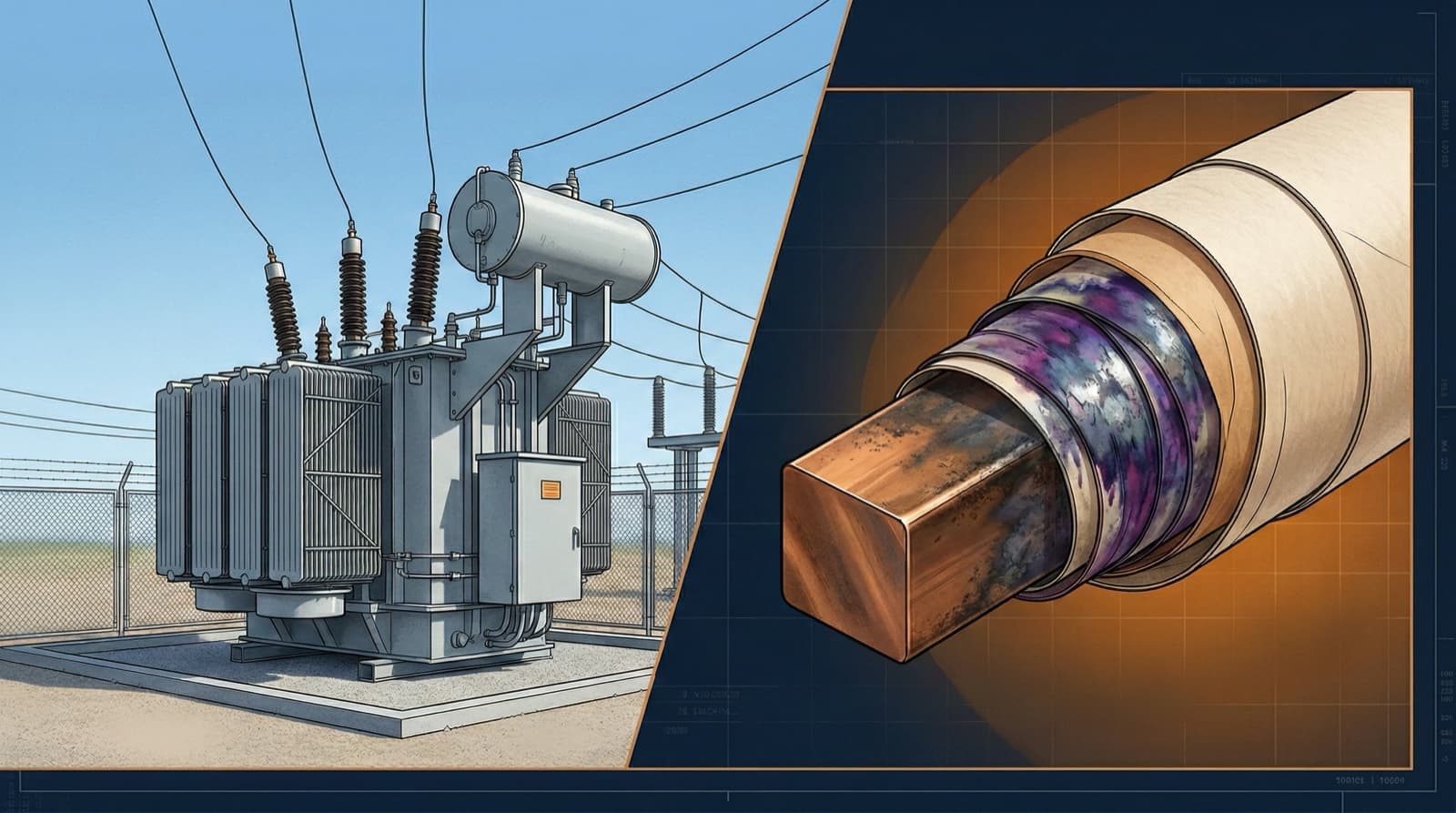
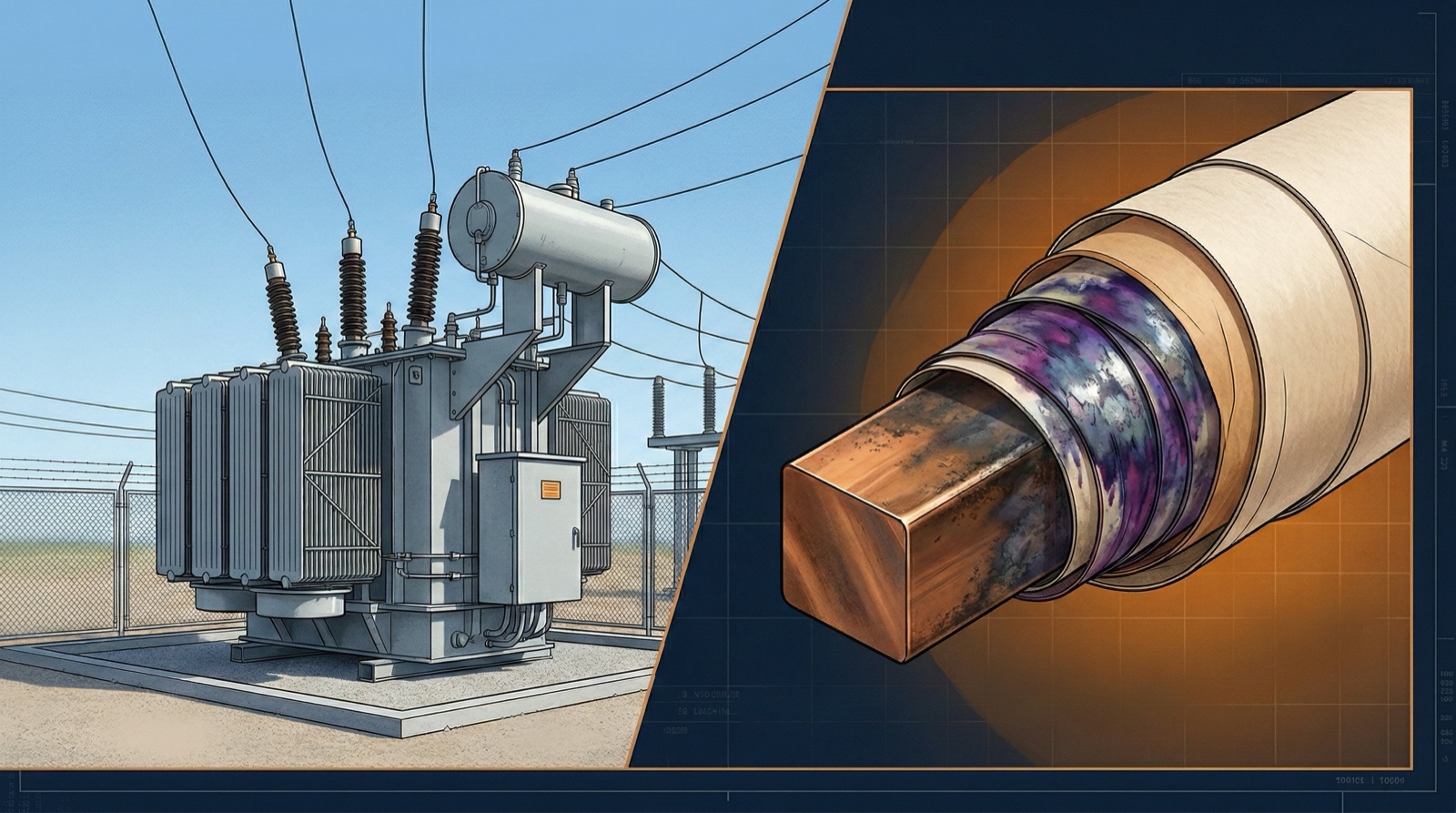
The root cause was not equipment defect or operational negligence. It was a chemistry problem: dibenzyl disulfide (DBDS), a sulfur compound introduced into transformer oil formulations during the 1990s, was silently destroying paper insulation from the inside out. Most alarmingly, conventional Dissolved Gas Analysis (DGA) — the industry's primary diagnostic tool — provided no warning whatsoever before failure.
This whitepaper provides a practical, practitioner-oriented guide to the corrosive sulfur phenomenon: what happened, why it happened, how to detect it, and — most importantly — what asset managers should do about it today. We present a pragmatic, tiered approach to testing and mitigation designed for the real-world constraints of limited budgets, competing priorities, and aging transformer fleets.
1. The Crisis: What Happened and Why
For decades prior to the year 2000, the prevailing wisdom in the power industry held that corrosive sulfur was an obsolete problem — a relic of poorly refined oils that had been solved by modern processing technology. Utilities purchased premium transformer oils from reputable major suppliers with full confidence that sulfur-related corrosion was not a concern. That confidence was misplaced.
The Three Converging Factors
The crisis was not caused by a single event but by the unfortunate convergence of three independent industry trends between approximately 1988 and 1995:
The hydrotreatment shift. Driven by environmental regulation and the depletion of traditional naphthenic crude sources, refineries adopted severe hydrodesulfurization processes. These were highly effective at reducing total sulfur content — from roughly 3,000 ppm down to below 100 ppm in many cases, as documented in the historical trend in Scatiggio et al. 2009 (IEEE Trans. Power Delivery, 24(3), Fig. 1, p. 1240). However, the process was chemically non-selective: it destroyed the naturally occurring thiophenic compounds that had historically served as the oil's built-in oxidation inhibitors and metal passivators.
The DBDS introduction. To compensate for the loss of natural oxidation stability, oil formulators introduced synthetic additives. Among these was dibenzyl disulfide (DBDS), a compound long used in industrial lubrication for its anti-wear properties. DBDS was added to transformer oil formulations at concentrations typically in the range 100–200 mg/kg, with individual oils sampled in the foundational study showing values between 100 and 350 mg/kg (Scatiggio et al. 2009, §II, p. 1241; CIGRE TB 625, §2.2.1, p. 6).
Transformer design evolution. Modern power transformers were increasingly designed to operate closer to thermal limits, with higher hot-spot temperatures, reduced cooling oil volumes, and sealed nitrogen-blanketed conservation systems that eliminated the protective influence of dissolved oxygen.
The Breakthrough Discovery
The critical diagnostic breakthrough was published by Scatiggio, Tumiatti, Maina, Tumiatti, Pompili and Bartnikas in 2009 (IEEE Transactions on Power Delivery, 24(3), pp. 1240–1248), working from the research programme run by Sea Marconi and the Italian TSO Terna. Using GC-AED (gas chromatography with atomic emission detection), the authors identified dibenzyl disulfide (DBDS) as the dominant corrosive species in the failing oils — present in the aged fluids as an intentional additive, not a refining residue (Scatiggio et al. 2009, §II, p. 1241). The paper further documented that approximately half of the mineral insulating oils introduced after 1990 tested positive for corrosive sulphur (Scatiggio et al. 2009, Introduction, p. 1240) — a prevalence figure that set the scale of the fleet-wide exposure.
The breakthrough shifted the industry's understanding of the problem. Total sulfur content is irrelevant — an oil with 2,000 ppm of stable thiophenic sulfur is perfectly safe, while an oil with less than 50 ppm total sulfur containing DBDS can destroy a transformer. The finding was absorbed into the IEC TC 10 process and became the chemistry foundation on which IEC 62697-1 (quantitative DBDS determination) and the risk-management framework of CIGRE TB 625 were subsequently built.
Historical Overview
| Era | Industry Assumption | Diagnostic Focus | Actual Outcome |
|---|---|---|---|
| Pre-1950s | Elemental sulfur causes rapid copper blackening | Visual inspection; early ASTM D130 adaptation | Problem deemed "solved" with basic refining controls |
| 1950s–1980s | Corrosive sulfur indicates cheap oil | ASTM D1275A (140°C / 19h) | High confidence in premium oils; minimal failures |
| 1988–1995 | Hydrotreating produces cleaner, better oil | Total sulfur measurement; routine DGA | Natural passivators destroyed; DBDS introduced as additive |
| 1999–2005 | Sudden unexplained catastrophic EHV failures worldwide | DGA fails to predict; oils pass D1275A | "Corrosive sulfur crisis." Billions in losses globally |
| 2005–2009 | DBDS identified; speciation-based assessment adopted | Scatiggio et al. 2009; IEC 62535; IEC 62697-1 (GC-MS); CIGRE TB 625 risk framework | Foundational diagnostic chemistry; quantitative risk management |
| 2009–present | DBDS-free oils mandated; mitigation of legacy fleet | IEC 62697-1 quantification; reclamation per IEEE C57.637-2015 | Active monitoring and DBDS-removal programmes |
Table 1: Historical evolution of the corrosive sulfur problem — from assumed obsolescence to global crisis to modern speciation-based management. Sources: Lewand (2002), Scatiggio et al. 2009, EPRI (2009), CIGRE TB 625 (2015), IEEE C57.637-2015.
2. The Chemistry: Why Some Sulfur Destroys Transformers and Some Does Not
Mineral insulating oil is a complex hydrocarbon matrix containing a variety of sulfur compounds from both the crude oil source and any additives. The critical insight of the post-crisis research — most rigorously established in Scatiggio et al. 2009 — is that corrosive potential depends entirely on the molecular architecture of individual sulfur species, not their total concentration.
| Category | Species | Risk Level |
|---|---|---|
| Highly Reactive (Corrosive) | Elemental sulfur (S₈); mercaptans/thiols (R-SH); dibenzyl disulfide (DBDS) | Critical — immediate to latent threat to copper and silver |
| Intermediate Reactivity | Sulfides/thio-ethers (R-S-R); sulfoxides; sulfones; dibenzyl sulfide (DBS) | Moderate — can participate in corrosion under thermal stress |
| Benign / Protective | Thiophenes; benzothiophenes; dibenzothiophenes (aromatic ring-stabilised sulfur) | Beneficial — natural oxidation inhibitors and metal deactivators |
Table 2: Classification of sulfur species in transformer oil by corrosive potential. The paradox of the refining shift was that hydrotreatment selectively destroyed the beneficial species while DBDS was subsequently added.
How DBDS Destroys Insulation: Two Parallel Pathways
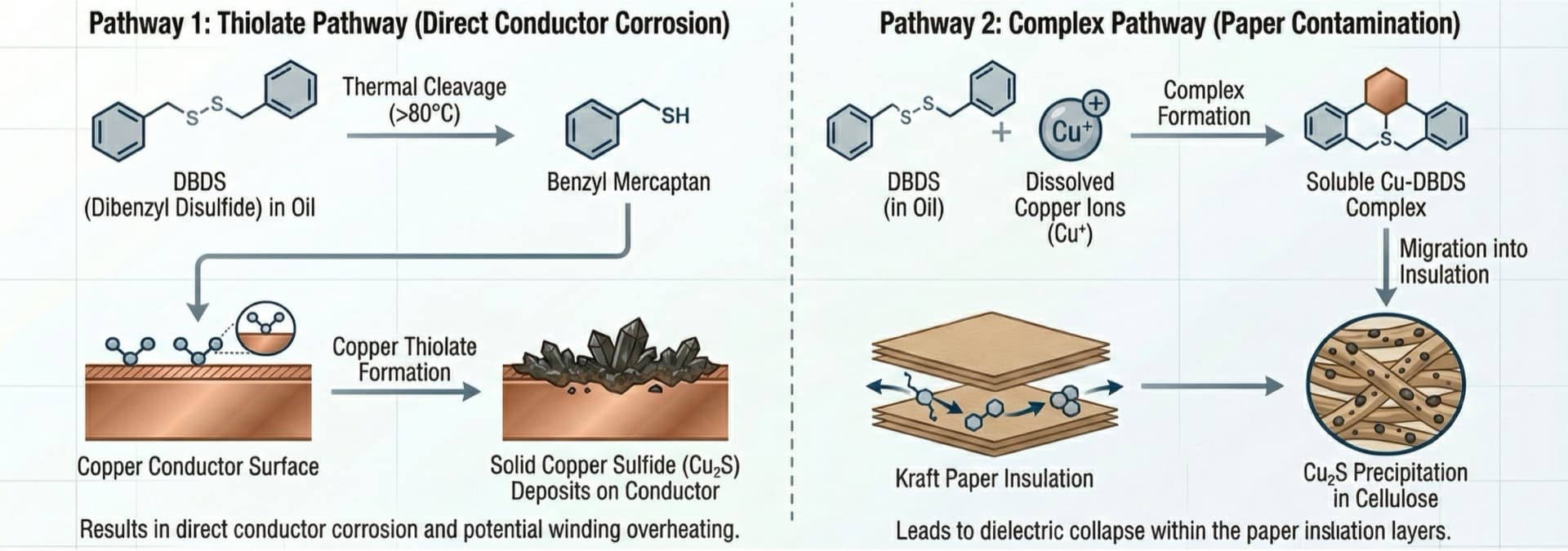
DBDS does not attack copper at ambient temperatures. The reaction is thermally triggered, with the critical S–S bond cleavage typically initiating above 80°C. The reaction rate approximately doubles with every 10°C increase, following classical Arrhenius kinetics. Two simultaneous pathways drive the damage:
The thiolate pathway (conductor corrosion). Thermal cleavage of DBDS generates highly reactive benzyl mercaptan, which adsorbs onto the copper surface, forming an unstable copper thiolate. This rapidly decomposes into solid crystalline copper sulfide (Cu₂S and Cu₇.₂S₄) deposited directly on the conductor.
The complex pathway (paper contamination). DBDS reacts with dissolved copper ions to form an oil-soluble organometallic complex (Cu-DBDS). Because this complex remains dissolved in the oil, it migrates away from the conductor and is adsorbed by the polar cellulose fibers of the Kraft paper wrapping. There, localised thermal stress causes the complex to decompose, precipitating semiconductive Cu₂S crystals directly into the paper matrix.
It is the second pathway that ultimately causes failure. The innermost paper layer — directly adjacent to the hot conductor — absorbs the highest concentration of copper sulfide. Scatiggio et al. 2009 (Fig. 13, p. 1245) report the normalised voltage breakdown strength as a function of paper layer position: outer paper layers retain near-nominal breakdown strength while the layer adjacent to the conductor shows breakdown strength reduced to roughly 1/20 of pristine. Doble Engineering training material cites approximate absolute values of ~1,800 V/mil (≈70 kV/mm) for pristine oil-impregnated Kraft paper falling to ~80 V/mil (≈3 kV/mm) in the heavily contaminated inner layer — a reduction exceeding 95% [VERIFICATION NEEDED — original Doble/Lewand citation not in TriboTech library; verify against Lewand (2002) Doble paper before re-publishing absolute values, or rephrase to use Scatiggio's normalised data only].
In-service DBDS depletion as diagnostic evidence. Scatiggio et al. 2009 monitored DBDS concentration in three shunt reactors over 18 months of full-load service and observed a 20–25% decrease in DBDS (Scatiggio et al. 2009, Fig. 5, p. 1241) — confirming that DBDS is actively consumed by the copper corrosion reaction in service, and providing a realistic benchmark for how fast the latent threat evolves in an unprotected unit.

The Diagnostic Blind Spots
Two characteristics make corrosive sulfur uniquely dangerous for asset managers relying on conventional condition monitoring:
DGA provides no warning. The copper sulfide precipitation process occurs at relatively low temperatures and does not generate the hydrocarbon gases (methane, ethylene, ethane) characteristic of conventional electrical or thermal faults. Samples taken as little as one day before catastrophic failure have shown no abnormal DGA signatures.
Paper mechanical strength remains intact. Copper sulfide deposition is not an acidic or hydrolytic degradation mechanism. Even in paper where dielectric strength has collapsed to 3.1 kV/mm, the Degree of Polymerisation (DP) typically remains at 900–938 — essentially "as new" mechanical condition. This means that neither DP testing nor furan analysis will detect an imminent corrosive sulfur failure. The paper looks healthy by every conventional measure except its ability to withstand voltage.
Environmental Factors That Accelerate the Problem
Oxygen does not behave monotonically — there is an optimum window. CIGRE TB 625 §2.2.2 (pp. 6–7) documents two separate oxygen regimes. In inhibited oils, the reaction that deposits copper sulfide on paper is maximised at an optimum range of a few thousand ppm dissolved O₂ — not at the extremes. Separately, increasing gas-phase oxygen above the oil from 2.5 % to 20 % promotes copper-surface deposition, especially in inhibited oils. The implication for asset management is therefore more subtle than "sealed systems are always worse": the risk depends on which mechanism dominates in a given unit, and on the interaction between dissolved O₂, passivator status, and inhibitor reserve.
Oil aging accelerates the process. As mineral oil ages, it generates carboxylic acids and hydroperoxides that accelerate copper ion dissolution into the bulk fluid, supercharging the formation of the oil-soluble Cu-DBDS complex.
Moisture raises the risk. Elevated moisture enhances ion mobility and lowers the threshold for complex decomposition within the paper.
3. Detection and Testing: Getting the Right Answer
The corrosive sulfur crisis exposed severe inadequacies in the industry's historical testing methodologies. In response, the international standards community developed a significantly more robust set of diagnostic tools. Understanding the strengths and limitations of each is critical for designing a cost-effective screening programme.
| Method | What It Measures | Key Strength | Critical Limitation |
|---|---|---|---|
| ASTM D1275A | General corrosivity (140°C / 19h) | Historical baseline data | Withdrawn. Test conditions too mild to trigger DBDS breakdown; produced massive false negatives |
| ASTM D1275B | General corrosivity (150°C / 48h) | Successfully triggers latent DBDS degradation | Bare copper strip only; cannot detect paper contamination. Susceptible to passivator masking |
| IEC 62535 (CCD) | Copper and paper corrosivity (150°C / 72h) | Paper-wrapped conductor replicates actual in-service failure mechanism. Detects any corrosive species, not just DBDS | Susceptible to passivator masking if oil has been treated with Irgamet 39 or similar |
| DIN 51353 | Silver corrosivity (100°C / 18h) | Highly sensitive to trace elemental sulfur and mercaptans threatening OLTC contacts | Does not reflect risk to bulk copper windings |
| IEC 62697-1 | Absolute DBDS concentration (mg/kg) via GC-MS | Unambiguous quantification; completely immune to passivator masking. Provides trendable numeric values | Only measures DBDS; does not detect non-DBDS corrosive species (mercaptans, elemental sulfur, oxidised sulfides) |
| FDS / PF Tip-Up | Dielectric loss (electrical test on the transformer) | The only non-destructive method to detect existing Cu₂S deposits inside the insulation | Requires taking the asset offline for electrical testing |
Table 3: Comparison of corrosive sulfur analytical methods. No single test covers all scenarios — effective risk management requires understanding which test answers which question. Sources: Lewand (2002), Scatiggio et al. 2009, EPRI (2009), IEC 62535 (2008), IEC 62697-1 (2012).
The Passivator Masking Effect: A Key Consideration
All qualitative corrosivity tests — including both ASTM D1275B and IEC 62535 — share a diagnostic vulnerability that practitioners must understand. If a corrosive oil has been treated with a metal passivator such as Irgamet 39, the passivator coats the test strip (and, in the CCD test, the paper-wrapped conductor), artificially inhibiting sulfide formation during the 48–72 hour laboratory test. The oil passes with a pristine visual rating, even though the underlying DBDS may still be present at dangerous concentrations.
This does not mean the passivator approach is ineffective in practice (see Section 5 below), but it does mean that a clean qualitative test result is diagnostically ambiguous if the passivator status of the oil is unknown. The only test that completely bypasses this masking effect is quantitative DBDS measurement via IEC 62697-1 (GC-MS), an approach whose scientific basis was established in Scatiggio et al. 2009.
Why Total-Sulfur Screening Is Not a Substitute
Total elemental sulfur content in insulating oil can be determined rapidly and inexpensively by energy-dispersive X-ray fluorescence (ED-XRF, ASTM D4294-24) or by wavelength-dispersive XRF (ASTM D2622 / ISO 14596). This is useful for certificate-of-analysis purposes and is embedded in the IEC 60296:2020 Table 3 limit of 0.05 % total sulphur for new oils.
⚠️ Warning
Total-sulfur screening is not a corrosive-sulfur screening. D4294 measures elemental sulfur across all chemical forms — stable thiophenes, benign sulfides, and the aggressive species (DBDS, mercaptans) indistinguishably. A passivated or severely hydrotreated oil can sit well below the IEC 60296 0.05 % limit and still historically have contained — or still contain — sufficient DBDS to precipitate copper sulphide under thermal load.
Corrosive-species identification requires either the Covered Conductor Deposition test (IEC 62535) or, preferably for passivated oils, quantitative DBDS measurement by GC-MS (IEC 62697-1). Total-sulfur belongs on the certificate-of-analysis line, not in the risk assessment.
4. Risk Assessment: Which Transformers Should You Worry About?
For utilities managing large fleets, blanket testing of every asset is rarely feasible. The CIGRE Technical Brochure 625 (2015) provides the definitive framework for risk-based prioritisation, classifying transformers by a combination of equipment demographics and oil test results.
High-Risk Equipment Profiles
- Manufacturing vintage 1999–2007. This window corresponds directly to the peak global distribution of hydrotreated, DBDS-containing oils — and overlaps with the Scatiggio et al. 2009 prevalence data showing approximately 50 % of post-1990 mineral-oil fills testing positive.
- High thermal duty assets. Generator Step-Up (GSU) transformers, HVDC converters, and large shunt reactors operate with inherently higher continuous hot-spot temperatures, directly driving the Arrhenius kinetics of DBDS breakdown. Any unit with documented continuous hot-spot temperatures exceeding 80°C warrants priority screening.
- Sealed / nitrogen-blanketed designs. As discussed in Section 2, the absence of dissolved oxygen dramatically accelerates the corrosion process.
- Bare copper conductors. Units utilising enamel-coated or varnished wire have a physical barrier that significantly retards sulfur adsorption.
The CIGRE TB 625 Risk Categories
| Category | Description | Recommended Action |
|---|---|---|
| C1 | Oil tests corrosive and DBDS is confirmed present via IEC 62697-1. Highest immediate threat profile. | Immediate mitigation: passivation and/or chemical depolarisation. Electrical testing (FDS/PF tip-up) to assess existing damage. |
| C2 | Oil tests corrosive, but DBDS is not detected. Corrosion driven by non-DBDS species (mercaptans, oxidised sulfides, or unidentified intermediates). | Specialised chemical treatment required. Standard Irgamet 39 passivation may be less effective against non-DBDS species. |
| C3 | Corrosion driven by localised thermal faults or arcing that pyrolyse stable sulfur compounds into reactive forms. | Address underlying thermal/electrical fault. Oil treatment secondary. |
| C4 | Non-sulfur related high copper dissolution driven by organic acids or excessive moisture. | Oil reclamation to reduce acidity and moisture. Investigate root cause of copper dissolution. |
Table 4: CIGRE TB 625 risk classification framework for corrosive sulfur in transformer insulation. The C1 and C2 classifications are most directly relevant to the DBDS issue discussed in this paper.
Intervention Thresholds
The current IEC 60422:2024 in-service maintenance standard reports the binary "non-corrosive / corrosive or potentially corrosive" classification (IEC 60422:2024, Table 5, p. 39–40). The 10 mg/kg DBDS figure originates in the CIGRE risk-management framework: per CIGRE TB 625, §4.4 (p. 81), if DBDS exceeds 10 mg/kg following the first passivator addition, a second passivator dose is recommended; sustained DBDS > 10 mg/kg combined with rapid passivator depletion and "Poor" oil condition (per IEC 60422 Table 5) is the threshold at which TB 625 recommends DBDS removal or oil change as a long-term solution. For new oils, IEC 60296:2020 requires DBDS to be below detection (< 5 mg/kg) when tested per IEC 62697-1.
5. Mitigation: What Are the Options?
When a transformer is identified as at risk, the operator faces a decision between several mitigation strategies. Each involves distinct trade-offs between cost, downtime, and long-term effectiveness.
Metal Passivation with Irgamet 39 (The Most Common First Response)
Per the CIGRE WG A2.40 survey of >1200 mitigation cases from 16 countries (CIGRE TB 625, §4.1.1, p. 49, Figure 53), metal-passivator addition was the initial intervention in 88% of cases (including 5% re-passivation), with oil change in 5%, oil reclamation/treatment in 4%, and other techniques or mixed actions in the remaining 5%. The standard passivator is Irgamet 39 (N,N-bis(2-ethylhexyl)-methylbenzotriazole), an oil-soluble compound that rapidly coordinates with copper ions on the metal surface to form an extremely thin (0.5–1 nm) but dense protective barrier.
Why passivation works and remains valid. Irgamet 39 physically isolates the copper surface from attacking mercaptans, free radicals, and organic acids. When properly applied at 100 ppm initial concentration and maintained above the 50 ppm minimum effective threshold, it effectively halts new copper sulfide formation. For asset managers who need an immediate, cost-effective response to a confirmed corrosive sulfur condition, passivation delivers reliable protection.
The ongoing commitment. Passivation does not neutralise or remove the DBDS itself — the chemical threat remains latent in the oil. The passivator is continuously consumed by thermal degradation, oxidation, and adsorption into the cellulose paper. This means that passivation creates a permanent monitoring requirement: Irgamet 39 concentration must be measured regularly (annually as a minimum, per IEC 60666), and re-dosing applied if the concentration drops below 50 ppm. Documented failures have occurred in reactors that were passivated but subsequently not monitored.
DGA Interpretation After Passivation
⚠️ Warning
Stray gas effect: Irgamet 39 undergoes thermal decomposition on the hot copper surface, generating "stray gases" — primarily hydrogen (H₂) and carbon monoxide (CO). In-service experience typically shows H₂ increases to approximately 100–150 ppm following passivation. For a diagnostician relying on Duval's Triangle or Rogers Ratios, this can trigger false-positive alarms for partial discharge (low CH₄/H₂ ratio < 0.1) or cellulose degradation (elevated CO).
Best practice: Establish a DGA baseline immediately prior to passivation. Monitor gas generation rates rather than absolute values in the months following treatment. See Stray Gassing: When Your DGA Report Is Telling You Nothing for the underlying lab-method context (CIGRE TB 927:2024).
Chemical Depolarisation / On-Line Oil Treatment (The Permanent Solution)
For a definitive resolution that eliminates the root cause, advanced chemical treatment processes — such as selective depolarisation or continuous on-line reclamation using specialised solid adsorbents — can physically strip DBDS from the oil, reducing concentrations to non-detectable levels (< 1 mg/kg). By destroying the DBDS itself, the risk of future copper sulfide formation is permanently eliminated, and the unit is freed from the ongoing passivator monitoring cycle.
Reclamation per IEEE C57.637-2015: Where It Fits
Reclamation — the controlled removal of oxidation products, moisture, and degraded additives from in-service oil using adsorbent media (Fuller's earth, activated alumina) combined with degassing and dehydration — is codified in IEEE Std C57.637-2015, IEEE Guide for the Reclamation of Mineral Insulating Oil and Criteria for Its Use (revision of IEEE Std 637-1985). For corrosive-sulphur management, reclamation is relevant for two reasons:
- Adsorbent processes can reduce DBDS along with acidity and oxidation products. Properly specified Fuller's earth column treatment removes polar species from the oil, and DBDS-class disulphides partition into the adsorbent along with the other targets. Reclamation is therefore a potential route to lower DBDS concentration without full oil replacement, particularly for units where acidity and IFT have also degraded and reclamation was already warranted on oil-quality grounds.
- Reclamation criteria and post-reclamation verification are defined. IEEE C57.637-2015 specifies the property thresholds that trigger reclamation, the process controls during treatment, and the acceptance criteria for returning the oil to service. For transformers treated for corrosive sulphur, these criteria are the backbone of the post-treatment verification plan.
In practical terms, reclamation sits between passivation (fast, protective, latent-risk-intact) and chemical depolarisation (slow, DBDS-destructive, permanent). For a unit that qualifies for reclamation on general oil-quality grounds and has a corrosive-sulphur concern, the two objectives can sometimes be served by a single, appropriately specified reclamation campaign — provided the adsorbent, residence time, and verification methodology are explicitly designed to cover both. IEEE C57.637-2015 provides the reference framework; the specification work is an engineering exercise that should draw on both the IEEE guide and CIGRE TB 625.
Reclamation is not applicable to natural or synthetic ester fluids (IEEE C57.637-2015, Scope), which is one of several reasons why corrosive-sulphur management strategy differs fundamentally between mineral-oil and ester-filled populations.
Oil Replacement (The Intuitive But Flawed Option)
Draining and replacing the oil appears logical but is practically problematic. Approximately 10–15% of the contaminated oil remains trapped in the pressboard, paper wrappings, and core cavities of a large transformer. Upon re-energisation, this residual oil rapidly leaches DBDS back into the fresh oil, re-contaminating the entire volume. If oil replacement is chosen, best practice mandates immediate passivation of the new oil to neutralise this "bounce-back" effect — which largely negates the economic advantage over on-line chemical treatment.
Mitigation Options at a Glance
| Strategy | Relative Cost | Speed of Deployment | Eliminates DBDS? | Ongoing Commitment |
|---|---|---|---|---|
| Irgamet 39 passivation | Low (€5–15K per unit) | Rapid (days) | No — masks but does not remove DBDS | Lifelong monitoring + periodic re-dosing |
| Reclamation (IEEE C57.637-2015) | Moderate | Days to weeks (offline or on-line) | Partial — adsorbent removal along with oil-quality restoration | Post-reclamation verification; re-passivation may still be advisable |
| Chemical depolarisation | Moderate–High | Weeks (can be on-line) | Yes — permanently | Minimal once complete |
| Oil replacement | High (€200K–1M+ for large units) | Extended outage required | Partially — 10–15% residual | Must add passivator to new oil regardless |
| Transformer replacement | Very High (€2–15M installed) | 18–60 months lead time | Yes — eliminates the asset entirely | None (new unit) |
Table 5: Comparison of mitigation strategies for corrosive sulfur. The right choice depends on asset criticality, confirmed DBDS concentration, the extent of existing paper damage, and available capital and outage windows. Sources: CIGRE TB 625, IEEE C57.637-2015, ABB (case study).
Cost ranges shown (€5–15K passivation, €200K–1M+ oil replacement, €2–15M transformer replacement) are indicative 2024–2025 European market values drawn from TriboTech project quotations, vendor list-price ranges, and published utility tender data. Actual costs vary significantly with unit MVA, voltage class, transport access, oil volume, lead-time pressure, and contract scope. Use these ranges only for order-of-magnitude planning; obtain firm vendor quotes for budgetary approval [TRIBOTECH EXPERIENCE].
❗ Important
The limitation that no treatment can overcome: No chemical treatment — regardless of sophistication — can reverse, dissolve, or extract copper sulfide crystals that have already precipitated into the paper. If dielectric strength has already been compromised, treatment prevents further deterioration but cannot restore lost insulation capacity.
6. A Pragmatic Approach to Corrosive Sulfur Management
At TriboTech, our philosophy has always been to deliver actionable advice that reflects the real-world constraints our clients face. Transformer asset managers operate with limited budgets, competing maintenance priorities, and finite outage windows. The objective is not to eliminate every conceivable risk within one narrow issue, but to achieve maximum impact with available resources by addressing the most significant threats first.
The Foundation: IEC 62535 Remains a Sound Starting Point
Our established recommendation — testing with IEC 62535 (the Covered Conductor Deposition test) and passivating with Irgamet 39 when the oil is confirmed corrosive — is a proven, effective approach. The IEC 62535 test is the most representative simulation of the actual in-service failure mechanism: it captures both copper corrosion and the critical paper migration pathway that ultimately causes dielectric collapse. Importantly, it responds to all corrosive sulfur species, not only DBDS.
Clients who have followed this advice are protected, provided the recommended follow-up is maintained. Specifically: regular re-testing with IEC 62535 at appropriate intervals to verify continued non-corrosivity, and periodic re-dosing of Irgamet 39 if the oil was confirmed corrosive and passivated. As long as the passivator concentration remains above the 50 ppm effective threshold and is periodically verified, the protective barrier on the copper surface remains intact and no new copper sulfide will form.
An Opportunity to Strengthen the Programme Further
As our understanding of the corrosive sulfur landscape has matured — informed by the foundational diagnostic chemistry of Scatiggio et al. 2009, two decades of field experience, the extensive work of CIGRE WG A2.32 and A2.40, and the lessons documented in Technical Brochures 378 and 625 — we believe there is now an opportunity for clients with critical, high-value assets to strengthen their screening programmes with an additional layer of specificity.
The enhancement centres on the addition of quantitative DBDS measurement (IEC 62697-1) as a complementary test for specific high-risk scenarios. This is not a replacement for IEC 62535, but an additional tool that addresses one specific gap: the passivator masking effect.
When an oil has been treated with Irgamet 39, all qualitative corrosivity tests, including IEC 62535, will return a "non-corrosive" result regardless of how much DBDS the oil actually contains. In most cases this is not a practical problem, because the passivator is doing its job. But it does mean that qualitative tests cannot confirm whether the underlying risk has been eliminated or merely suppressed. Quantitative DBDS measurement via GC-MS bypasses this masking effect entirely, providing a definitive concentration value that can be trended over time.
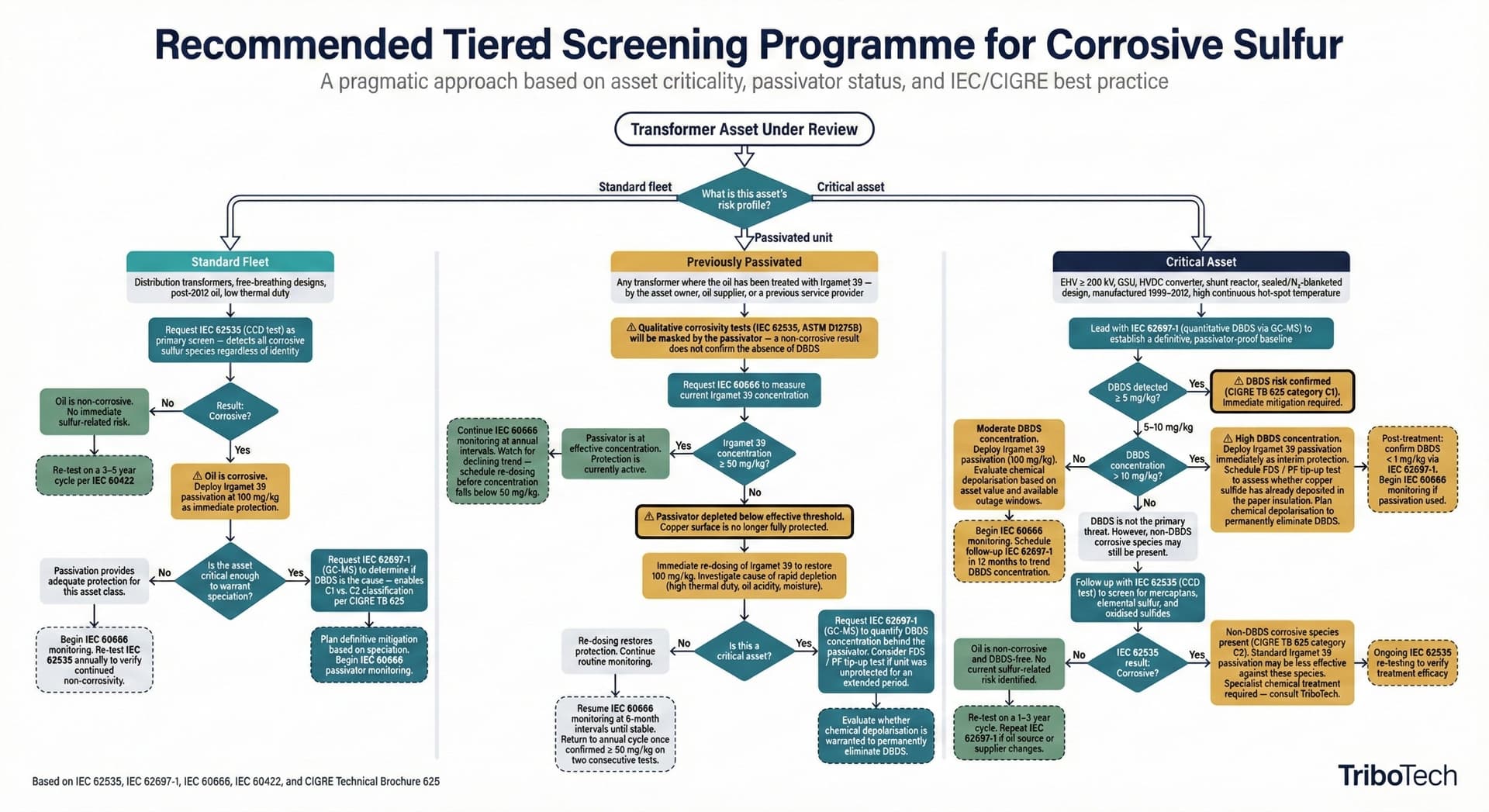
Recommended Tiered Approach
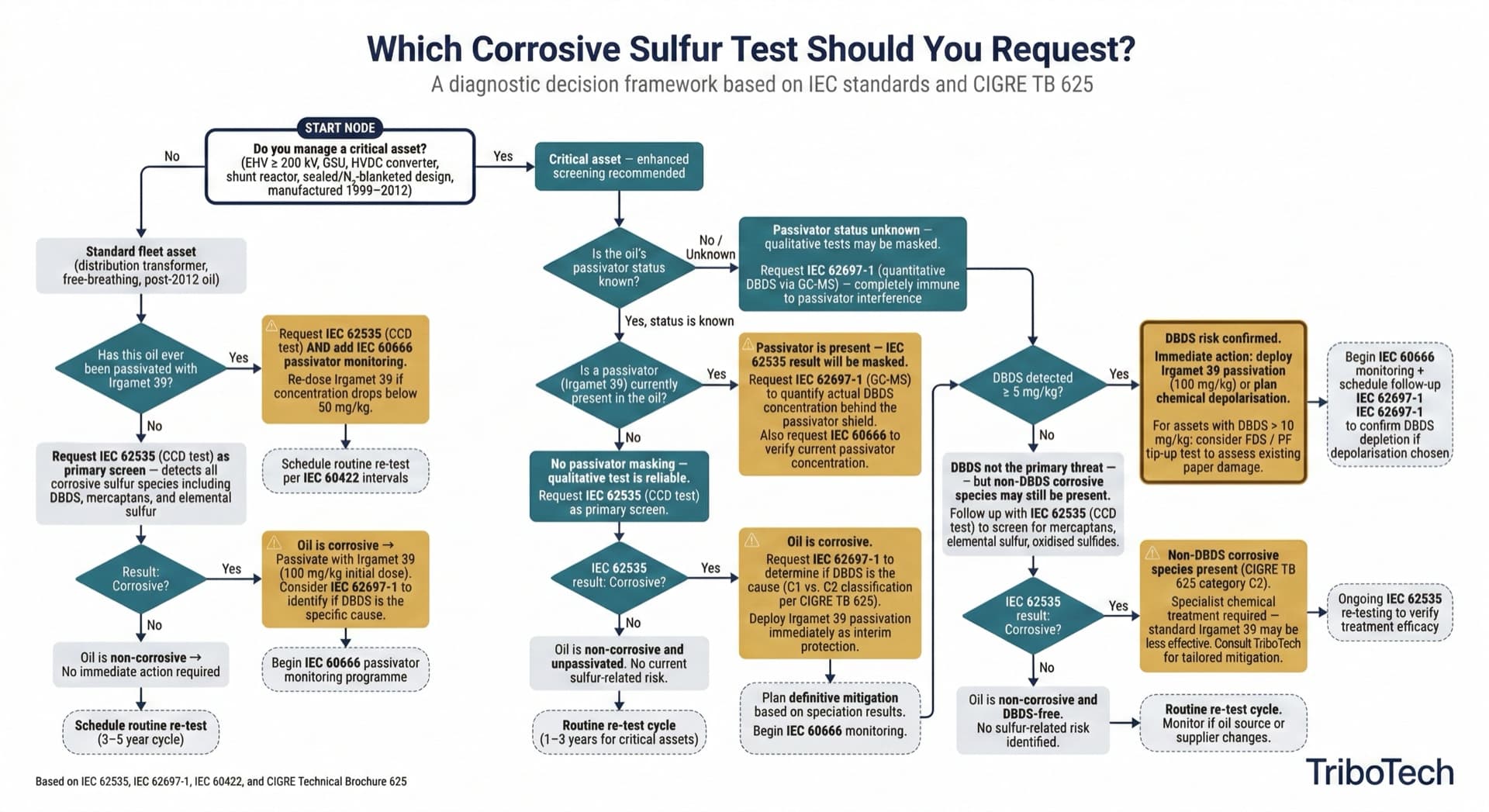
For critical EHV/GSU/HVDC assets (especially manufactured 1999–2012, sealed designs): Consider leading with IEC 62697-1 (DBDS quantification) to establish a definitive, passivator-proof baseline. If DBDS is detected above 5 mg/kg, the risk is confirmed and mitigation can be immediately planned. If DBDS is below detection limits, follow up with IEC 62535 to screen for non-DBDS corrosive species (the C2 risk profile per CIGRE TB 625).
For the broader fleet (distribution transformers, free-breathing units, post-2012 oil): IEC 62535 alone continues to provide excellent, cost-effective screening. The probability of undocumented passivation in these populations is substantially lower, and the CCD test's ability to detect all corrosive species — regardless of their identity — is a genuine practical advantage.
For any transformer where the oil has been passivated: Add Irgamet 39 concentration monitoring (IEC 60666) as a standard element of the ongoing maintenance programme. A declining passivator trend is among the most actionable early warnings available — it signals that the protective barrier is being consumed and re-dosing is required before the protection is lost.
For units where oil quality has degraded alongside a corrosive-sulphur concern: Consider whether a single reclamation campaign per IEEE C57.637-2015 — appropriately specified to address both the quality-based and sulphur-based objectives — could serve the remediation plan more efficiently than parallel passivation and later reclamation.
7. The Economic Case: Why Testing Pays for Itself Many Times Over
The economics of corrosive sulfur are unambiguous: the cost of testing and mitigation is trivial compared to the cost of a single catastrophic failure.
A comprehensive five-year study by Hartford Steam Boiler and the IMIA documented 94 major power transformer losses between 1997 and 2001, totalling 86 million per event. Replacement costs for EHV transformers range from approximately €2 million to over €15 million installed, with current lead times of 18–60 months depending on the complexity of the design.
Against these figures, fleet screening costs are negligible — typically less than 0.05% of transformer replacement value for advanced speciation testing, and well under 1% for passivation. A single prevented failure pays for the screening of an entire fleet many times over.
8. Emerging Risks: Silver Corrosion and Climate Impacts
While the DBDS-driven copper corrosion crisis is now well understood and addressed by current standards, two emerging concerns warrant attention from forward-thinking asset managers.
Silver corrosion in tap changers. Silver-plated contacts in On-Load Tap Changers (OLTCs) are exponentially more reactive to sulfur than copper, forming brittle, conductive silver sulfide (Ag₂S) at ambient temperatures from sub-ppm concentrations of elemental sulfur or specific mercaptans. Critically, the standard Irgamet 39 passivator provides negligible protection for silver. CIGRE has established Joint Working Group D1/A2.84 specifically to develop new analytical techniques for ultra-low elemental sulfur detection and silver-compatible passivator chemistries.
Climate-driven acceleration. Because corrosive sulfur reactions follow strict Arrhenius kinetics (approximately doubling every 10°C), sustained increases in ambient temperature directly accelerate the degradation timeline for any transformer containing latent DBDS. For heavily loaded transformers in warming climates, the remaining intervention window may be shorter than historical models predict.
9. Key Takeaways for Asset Managers
-
Total sulfur content tells you nothing about corrosive potential. An oil with very low total sulfur can be highly dangerous if it contains DBDS; an oil with high total sulfur can be perfectly safe if that sulfur is in stable thiophenic form — the diagnostic chemistry first rigorously established by Scatiggio et al. 2009.
-
DGA will not warn you. Corrosive sulfur operates below the thermal threshold of conventional fault gas generation. A clean DGA report provides no assurance against an impending DBDS-related failure.
-
The paper looks healthy until it fails. DP and furan testing reflect mechanical degradation; copper sulfide causes electrical failure through a completely different mechanism. Conventional insulation life models may overestimate remaining life in affected units.
-
Passivation works, but it is a commitment. Irgamet 39 provides reliable protection when properly maintained. The key word is "maintained" — passivator concentration must be monitored and re-dosed when it drops below 50 ppm.
-
Reclamation per IEEE C57.637-2015 is a legitimate remediation route for units where oil quality has degraded alongside the corrosive-sulphur concern — not a universal answer, but a tool that belongs in the toolbox alongside passivation and chemical depolarisation.
-
No treatment reverses existing damage. Passivation, reclamation, and chemical depolarisation prevent further deterioration, but none can extract copper sulfide crystals already embedded in the paper insulation.
-
Test the oil before use. New oil should be independently tested for DBDS and corrosivity before filling any transformer, regardless of supplier certifications. The era of assuming major-brand oil is inherently safe is over.
References
- Scatiggio, F., Tumiatti, V., Maina, R., Tumiatti, M., Pompili, M., & Bartnikas, R. (2009). "Corrosive Sulfur Induced Failures in Oil-Filled Electrical Power Transformers and Shunt Reactors." IEEE Transactions on Power Delivery, vol. 24, no. 3, pp. 1240–1248, July 2009. DOI: 10.1109/TPWRD.2008.2005369.
- CIGRE Technical Brochure 625, Copper Sulphide Long Term Mitigation and Risk Assessment, WG A2.40, 2015.
- CIGRE Technical Brochure 378, Copper Sulphide in Transformer Insulation, WG A2.32, 2009.
- IEEE Std C57.637-2015, IEEE Guide for the Reclamation of Mineral Insulating Oil and Criteria for Its Use (Revision of IEEE Std 637-1985), IEEE Power & Energy Society, 2015. IEEE standards page.
- IEC 62535:2008, Insulating liquids — Test method for detection of potentially corrosive sulphur in used and unused insulating oil.
- IEC 62697-1:2012, Test methods for quantitative determination of corrosive sulfur compounds in unused and used insulating liquids.
- IEC 60422:2024 (ED5), Mineral insulating oils in electrical equipment — Supervision and maintenance guidance, IEC TC 10. Supersedes IEC 60422:2013 (ED4).
- IEC 60296 Ed. 5 (2020), Fluids for electrotechnical applications — Unused mineral insulating oils.
- L. R. Lewand, "The Role of Corrosive Sulfur in Transformers and Transformer Oil," Doble Engineering, 2002.
- L. Lewand and S. Reed, "Destruction of Dibenzyl Disulfide in Transformer Oil," Doble Engineering, 2008.
- EPRI, "Understanding and Mitigating Corrosive Sulfur Risks in Oil-Filled Transformers," Report 1022573, 2009.
- F. Scatiggio et al., "Formation of Corrosive Sulfur with Dibenzyl Disulfide in Fluid-Filled Transformers," Ind. Eng. Chem. Res., 2016.
- CIGRE Chile, "Influence of Corrosive Sulfur on the Worldwide Population of Power Transformers," cigre.cl (presentation).
- Sea Marconi Technologies, "Establishment of Corrosive Sulfur," seamarconisolution.com.
- P. J. Griffin and L. R. Lewand, "Understanding Corrosive Sulfur Problems in Electric Apparatus," Doble Engineering, 2007.
- Hrcak (Croatian Scientific Portal), "Sulfur Corrosion Phenomena," hrcak.srce.hr/file/352100.
- Hrcak, "Metallic Sulfides Deposited in Paper Insulation," hrcak.srce.hr/file/412842.
- Norwegian Research Information Repository, "Investigation of Dielectric Response Measurement as a Tool to Detect Copper Sulphide," nva.sikt.no.
- Soltex, Inc., "Stop Corrosive Sulfur: A Successful Multi-Directional Approach," soltexinc.com.
- F. Wan and J. Qian, "Suppressive Mechanism of the Passivator Irgamet 39 on the Corrosion of Copper Conductors," Semantic Scholar.
- F. Wan et al., "Suppressive mechanism of the passivator irgamet 39," ResearchGate.
- L. R. Lewand, "Effects of Metal Deactivator Concentration upon the Gassing Characteristics of Transformer Oils," ResearchGate, 2009.
- ResearchGate, "Inhibition Effectiveness and Depletion Characteristic of Irgamet 39 in Transformer Oil," 2017.
- ResearchGate, "Gas Production Mechanism of Irgamet 39 and Its Long-Term Corrosion Resistance," 2023.
- ResearchGate, "Investigation on the Effects of Irgamet 39 on Stray Gassing Generation," 2021.
- ABB, "Transformer Oil Reclamation Service Prolongs Active Life for Deeside Power Station's GSU Transformers" (case study).
- HV Assets, "Transformer Failures: Financial Losses Analysis and Prevention Strategies."
- Doble Engineering, "Lessons Learned from Analysis of Power Transformer Failure Rates," IEEE CONCAPAN, 2022.
- CSE (CIGRE Science & Engineering), "Silver Corrosion in Liquid-Filled Transformers," cse.cigre.org, Issue 38.
- CIGRE JWG D1/A2.84, "Proposal for the Creation of a New Working Group: Silver Corrosion in Power Transformers," 2025.
Disclaimer: This whitepaper is provided for informational and educational purposes by TriboTech ApS. While every effort has been made to ensure accuracy, the information herein does not constitute engineering advice for any specific transformer or installation. Testing and mitigation decisions should be made in consultation with qualified professionals based on the specific circumstances of each asset. TriboTech ApS accepts no liability for actions taken or not taken based on this publication.
Need Help Assessing Your Fleet?
Use our free Duval Diagnostic Tools for DGA analysis, or contact us for a consultation on corrosive sulfur screening and mitigation strategies for your transformer fleet.
For more insights on oil diagnostics, read:
- Navigating the DGA Maze — A guide to IEC vs IEEE standards.
- What Your Transformer Oil Is Telling You — The basics of oil quality testing.
- Stray Gassing: When Your DGA Report Is Telling You Nothing — Context for post-passivation DGA interpretation.
Put Theory into Practice
Try our interactive Duval diagnostic tools or use our new unified workflow to analyze your transformer oil data.